
2007 · Construction de territoires
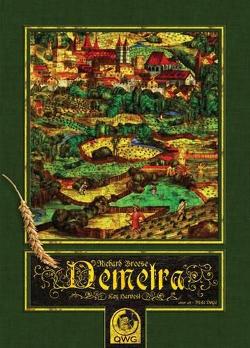
Demetra
Les joueurs construisent leur propre plateau de pays en acquérant et en plaçant des tuiles de champs, puis marquent des points pour les groupes de champs connectés et les tuiles d’ouvriers placées sur leur plateau. À son tour, un joueur effectue deux actions distinctes parmi quatre possibilités : placer des champs de sa réserve sur son plateau, prendre des champs du registre pour les mettre dans sa réserve en misant des jetons de récolte (les autres joueurs peuvent égaler l’enchère pour acheter la tuile), placer un ouvrier (ouvrier agricole) adjacent au nombre requis de champs pour déclencher son action spéciale, ou récolter des cultures en retournant les tuiles de champs non récoltées. Les tuiles de champs piochées dans le sac renouvellent le registre et peuvent inclure des tuiles Événement qui affectent tous les joueurs ; la partie se termine après le dixième événement, suivi de deux tours supplémentaires. Le décompte final attribue également des points pour la majorité dans chaque type de culture.
- Joueurs
- 2–4 idéal à 3
- Temps de jeu
- 90 min
- Âge
- 10+
- Complexité
- 3 / 5
À propos du jeu
- Auteurs
- Illustration
- Éditeur



Sur les tables de Ludoya
Toutes les statistiques dans Ludoya- 8
- Parties enregistrées
- 5
- Joueurs
- 7
- Dans des collections
5,7/10
sur 5 avis Ludoya
Mestremuten4,5 Rating: 2/5 Production value: 2/4 Is the game in my collection/Love to have?: 0.5/1
Premières impressions · 1 partie
Evan6,0 This is a tile laying game where each player has a symmetrical player board full of spaces that each have a unique unique row and column designation. Tiles get mixed in a bag and then six are placed on the central board. On each player's turn, they can do 2 actions, which could be place a worker tile and use it's special ability so long as the worker goes next to a number of other tiles at least equal to his printed victory point value, or take tiles from the central display placing them up for sale on your market area by setting their price with goods tokens, getting resource tokens from a connected blob of tiles on your player board thereby depleting the tiles, or buying tiles from player's market spaces which could be your own, or someone elses. The game ends when ten event tiles from the bag get drawn and resolved. Then, players score the printed values of the workers they have remaining on their board, plus 1 point for every tile in their largest blob, and 2 points for every tile in their second largest blob. Then there are a few mini points for having the most remaining of each type of good token. The game is very tight, with difficult decisions throughout. The mechanism where tiles taken from the central board need to go into your market where someone else might buy it from you is interesting but at times difficult to manage. You need to have an eye on the tiles you need, but also the tiles other people need so you can set them up to have to pay you, but then setting the price is tricky. Tiles can only go in the specific grid spot printed on them, which makes it tough if someone buys out a tile you needed to connect your stuff. On the other hand if you want someone to pay you for a tile, you have to set the price at a level they can afford using colors they have, and resources in hand are kept secret, so tracking who spent what when is another mental effort in addition to tracking what tile is good for who. Under-price the tile and you feel like a chump. Overprice the tile, and it just sits there until someone buys it, and your resources you used to set the price stay with the tile, and you again feel like a chump. The graphic design is very busy. The player workers are clear to see, but the neutral workers players are in competition for look very similar in color and pattern to the farm tiles, which makes being able to clearly see other player's board states more difficult than it needs to be. The tiles also can be a little misleading as to what their effects are. You really have to check the book before the game to clarify how they work. With some graphic design improvements, this could be a fantastic game. As it stands, I very much enjoy the puzzle. Particularly the mechanism where you can get extra activations from your workers if you place a field tile on them and bump them to another space they can legally go. It's irritating that while the worker and event tiles have english text on them, the text is misleading and you have to check the rulebook to see what they do each time. It would be better if all they had was a letter on them and then you reply entirely on a player aid to look up their ability. It would also be good if they included some kind of marker that would visually track who had which tiles so you aren't waiting for something that will never be available as each tile is unique. When I play I often use a sets of colored glass counters for this purpose
Y a joué 4 fois
Tom5,5 The game works well, but it feels too "gamey" to be fun. I don't know how to put it better, but it doesn't have the sheer fun that Reef Encounter and Keythedral have.
Aucune partie enregistrée



Gratuit, sur le web, Android et iOS
Jouez à Demetra avec Ludoya
- Gardez-le dans votre collectionSuivez votre exemplaire et ses extensions, prêtez-le à vos amis ou ajoutez-le à votre liste de souhaits et soyez prévenu quand le prix baisse.Ajouter à votre collection
- Enregistrez chaque partieScores, gagnants, minuteurs et photos, puis vos statistiques : taux de victoire, nombre de joueurs préféré, meilleur score.Enregistrer une partie
- Comptez les points sans papierUtilisez les feuilles de score et les aides de jeu de la communauté, et laissez Ludoya additionner les points.Trouver des feuilles de score
- Trouvez des gens avec qui y jouerClubs, soirées jeux et événements près de chez vous qui mettent ce jeu sur la table.Voir les événements
Données du jeu (joueurs, durée, âge, crédits) issues de BoardGameGeek.