
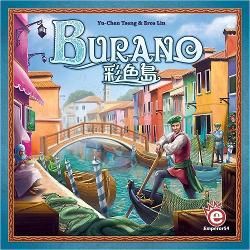
2015 · Construction de villes
Burano
Les joueurs dirigent une famille sur une petite île vénitienne au fil de quatre saisons, en affectant ses membres au travail, au développement et à la vente de marchandises. Les actions incluent envoyer les hommes pêcher, envoyer les femmes produire de la dentelle destinée à l’exportation, ainsi que réparer les toits ou peindre les maisons le long des canaux. Le jeu utilise un moteur en forme de pyramide de cubes : les joueurs dépensent des pièces pour utiliser une pyramide à code couleur qui déclenche des actions spécifiques à chaque manche. Les ressources et les actions rapportent des points de victoire grâce à la production, aux ventes et à l’amélioration des bâtiments au cours de 14 manches. Le jeu met l’accent sur l’optimisation du placement des ouvriers, le bon timing des opérations de la pyramide et l’équilibre entre revenus et réputation à long terme.
- Joueurs
- 2–4 idéal à 3
- Temps de jeu
- 90–120 min
- Âge
- 12+
- Complexité
- 3,8 / 5
À propos du jeu
- Auteurs
- Illustration
- Éditeur


Où l'acheter
Prix des boutiques et exemplaires d'occasion, vérifiés chaque jour.
Sur les tables de Ludoya
Toutes les statistiques dans Ludoya- 9
- Parties enregistrées
- 14
- Joueurs
- 1h 47m
- Partie moyenne
- 17
- Dans des collections
- 1
- Dans des listes de souhaits
5,7/10
sur 8 avis Ludoya
Evan5,0 Placing delightful colored cubes next to each other or on top of each other as an action selection method is really delightful. It's an interesting and colorful puzzle I fully enjoy. I wish I could say the same about the rest of the game. From what I've read, the second edition of the game solves a lot of the problems I've read about in the first edition, but the game still has a few issues. There appears to be a strong first player advantage. It's not hard for the first player in turn order to grab up a few majorities and drop some big scoring roof tiles before anyone has a reasonable chance to contest them. There's no difference in starting positions for players later in turn order, and they don't have these same opportunities for scoring without battling anyone. The house cards that are earned for placing roof tiles are of wildly different levels of usefulness. For example, all the cards that give you points are points locked in for the rest of the game, except one type of card that gives you points for each person you have in a contestable area. This appears to be an unintentional weakening from a change from 1st to 2nd edition that was paid no attention. The game does have a lot of flip luck, in terms of what fish cards come up, which house cards are available at any given time, and what color roof tiles you randomly draw. The last thing is the actions that you take just aren't that compelling. On your turn you get 1-4 actions, and each action you take means you spend more money. A compelling idea, but when half your actions consist of moving a cube from your pyramid to your "ready area", the efficiency and opportunities for clever moves is overshadowed by a stale feeling. Overall, the game isn't bad for a tactical game, but it doesn't shine as a strategy game, which is a real pity as I love putting bricks on top of other bricks. ★ Art, Iconography and components functional ★ Clever or interesting mechanisms ☆ Reasonably low downtime between turns with mildly AP players ★ Multiple plays stay interesting ★ Low or mitigatable luck elements ★☆☆☆☆ Raw enjoyment
Premières impressions · 1 partie






Gratuit, sur le web, Android et iOS
Jouez à Burano avec Ludoya
- Gardez-le dans votre collectionSuivez votre exemplaire et ses extensions, prêtez-le à vos amis ou ajoutez-le à votre liste de souhaits et soyez prévenu quand le prix baisse.Ajouter à votre collection
- Enregistrez chaque partieScores, gagnants, minuteurs et photos, puis vos statistiques : taux de victoire, nombre de joueurs préféré, meilleur score.Enregistrer une partie
- Comptez les points sans papierUtilisez les feuilles de score et les aides de jeu de la communauté, et laissez Ludoya additionner les points.Trouver des feuilles de score
- Trouvez des gens avec qui y jouerClubs, soirées jeux et événements près de chez vous qui mettent ce jeu sur la table.Voir les événements
Données du jeu (joueurs, durée, âge, crédits) issues de BoardGameGeek.