
2006 · Économique
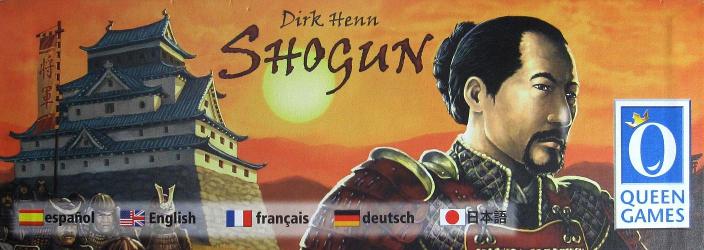
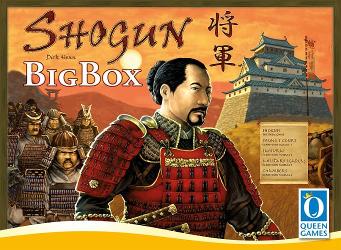
Shogun
Players take the roles of feudal lords in Japan’s Sengoku period, expanding influence by moving and raising troops, building structures, and contesting provinces. Each round players choose from a set of ten actions and assign them to their provinces to develop economy, mobilize forces, or trigger sieges. When opposing armies meet, a shared tower resolves combat: cubes representing troops are dropped in and those that fall out determine the battle outcome. Provinces, temples, theaters, and castles generate points at scoring, and the player with the most points at game end wins.
- Joueurs
- 3–5 idéal à 5
- Temps de jeu
- 90–120 min
- Âge
- 12+
- Complexité
- 3,4 / 5
À propos du jeu
- Auteurs
- Illustration
- Publisher


Extensions
Les voir dans Ludoya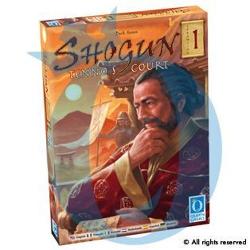
Où l'acheter
Prix des boutiques et exemplaires d'occasion, vérifiés chaque jour.
Sur les tables de Ludoya
Toutes les statistiques dans Ludoya- 113
- Parties enregistrées
- 181
- Joueurs
- 3h 4m
- Partie moyenne
- 47
- Dans des collections
- 6
- Dans des listes de souhaits
7,8/10
sur 35 avis Ludoya
Garfield8,0 #AreaControl Interesting area control game. [c] Theme: :star::star::star::nostar::nostar: <!-- size 7]Ok --> Gameplay: :star::star::star::star::nostar: <!-- size 7]Good amount of choices to make --> Interaction: :star::star::star::nostar::nostar: <!-- size 7]Battles for areas --> Artwork: :star::star::star::nostar::nostar: <!-- size 7]Simple artwork --> Luck: :star::nostar::nostar::nostar::nostar: <!-- size 7]Little to none --> Strategy: :star::star::star::star::nostar: <!-- size 7]Yes --> Components: :star::star::star::star::nostar: <!-- size 7]Good wooden components, but too small board --> Play duration: :star::star::star::nostar::nostar: <!-- size 7]Ok --> Easy to teach: :star::star::nostar::nostar::nostar: <!-- size 7]A lot to teach --> Rules quality: not yet read Setup time: :star::nostar::nostar::nostar::nostar: <!-- size 7]Preparing the area cards is a nightmare --> No downtime: :star::star::star::star::nostar: <!-- size 7]Plays quite fast --> Replay value: :star::star::nostar::nostar::nostar: <!-- size 7]Not that much I can think of --> [/c]
Mestremuten8,0 Rating: 4/5 Production value: 3/4 Is the game in my collection/Love to have?: 1/1
Questions de règles
Réponses tirées du livret par l'assistant de règles de Ludoya.
How do the 10 action cards work — what do up/down cards mean and in what order do actions resolve?
Each round the 10 action cards are arranged beneath fields 1–10 with the top 5 revealed (face up) and the bottom 5 face down; actions are executed in numeric order (1 then 2 ... then 10), revealing face‑down cards as you go. (p.6, p.9)
How is turn order decided — how do the special‑card auction and bids work?
Players secretly bid with chest cards or province cards, reveal and pay their bids, then in bid order choose a special card and place their Daimyo in that special’s slot to set turn order; province bids pay nothing but consume that province for the round. (p.6–9)
What do ‘Deploy 5 / Deploy 3 / Deploy 1’ cost and can I move armies when deploying?
Deploy 5 costs 3 chests and places 5 armies; Deploy 3 costs 2 chests and places 3; Deploy/Move 1 costs 1 chest and places 1 army and additionally allows moving armies from that province into one adjacent own province (no battling). Any number of armies may move to an adjacent province provided at least one army remains behind, and sea routes count as adjacency. (p.8)
How does the battle tower determine the winner and what happens to armies after a battle?
All participating armies plus any cubes in the tower tray are tossed into the tower; the armies that fall out into the tray are counted and the side with more cubes in the tray wins. The defeated side’s fighting armies are removed to supply, the victor also loses as many armies as the defeated side, and remaining victorious armies occupy the province (ties/undecided have special consequences described in the rules). (p.11–12)
What happens in winter if I don’t have enough rice — how are revolts chosen and resolved?
In winter each player must have one rice per province; unsupplied provinces determine how many revolts occur and how many additional farmer armies join (per the provisions table), then the besieged player’s left neighbor draws province cards to pick which provinces revolt — revolts are then resolved as battles with the extra farmers. (p.10–12)
If an event and a special card both modify an action, which one applies first?
Apply the event first and then apply the special card’s effect. (p.7)







Gratuit, sur le web, Android et iOS
Jouez à Shogun avec Ludoya
- Gardez-le dans votre collectionSuivez votre exemplaire et ses extensions, prêtez-le à vos amis ou ajoutez-le à votre liste de souhaits et soyez prévenu quand le prix baisse.Ajouter à votre collection
- Enregistrez chaque partieScores, gagnants, minuteurs et photos, puis vos statistiques : taux de victoire, nombre de joueurs préféré, meilleur score.Enregistrer une partie
- Réglez les questions de règlesPosez n'importe quelle question sur les règles et obtenez une réponse tirée du livret, avec la page pour vérifier.Demander à l'assistant de règles
- Trouvez des gens avec qui y jouerClubs, soirées jeux et événements près de chez vous qui mettent ce jeu sur la table.Voir les événements
Données du jeu (joueurs, durée, âge, crédits) issues de BoardGameGeek.