
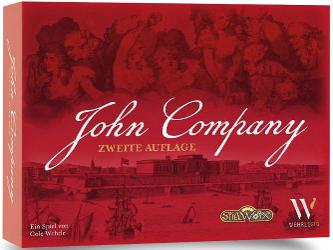
2022 · Politisch
John Company: Zweite Auflage
Die Spieler repräsentieren rivalisierende Familien, die eine vom Staat unterstützte Handelsgesellschaft nutzen, um im Großbritannien des 18. und 19. Jahrhunderts ihren persönlichen Wohlstand und sozialen Status zu mehren. Das Spiel läuft als gemeinsamer Unternehmensmotor ab: Die Spieler konkurrieren um Ämter in der Company, beeinflussen Unternehmensentscheidungen durch Verhandlungen und verwalten die Pensionierung von Familienmitgliedern, die ihren Dienst für die Company in Ländereien und Prestige umwandeln. Finanzielle Kredite, politisches Taktieren und soziale Kampagnen in der London Season prägen ebenfalls den Verlauf. Das Gameplay behandelt Imperialismus und globalen Handel als zentrale Themen und fordert die Spieler dazu auf, sich mit den Folgen auseinanderzusetzen; die Zustimmung der Gruppe zu diesem Thema wird empfohlen.
- Spieler
- 1–6 am besten mit 5
- Spielzeit
- 90–240 Min.
- Alter
- 13+
- Komplexität
- 4,4 / 5
Über das Spiel
- Autoren
- Illustration
- Publisher



Fotos von Ludoya-Tischen
Alle Fotos in Ludoya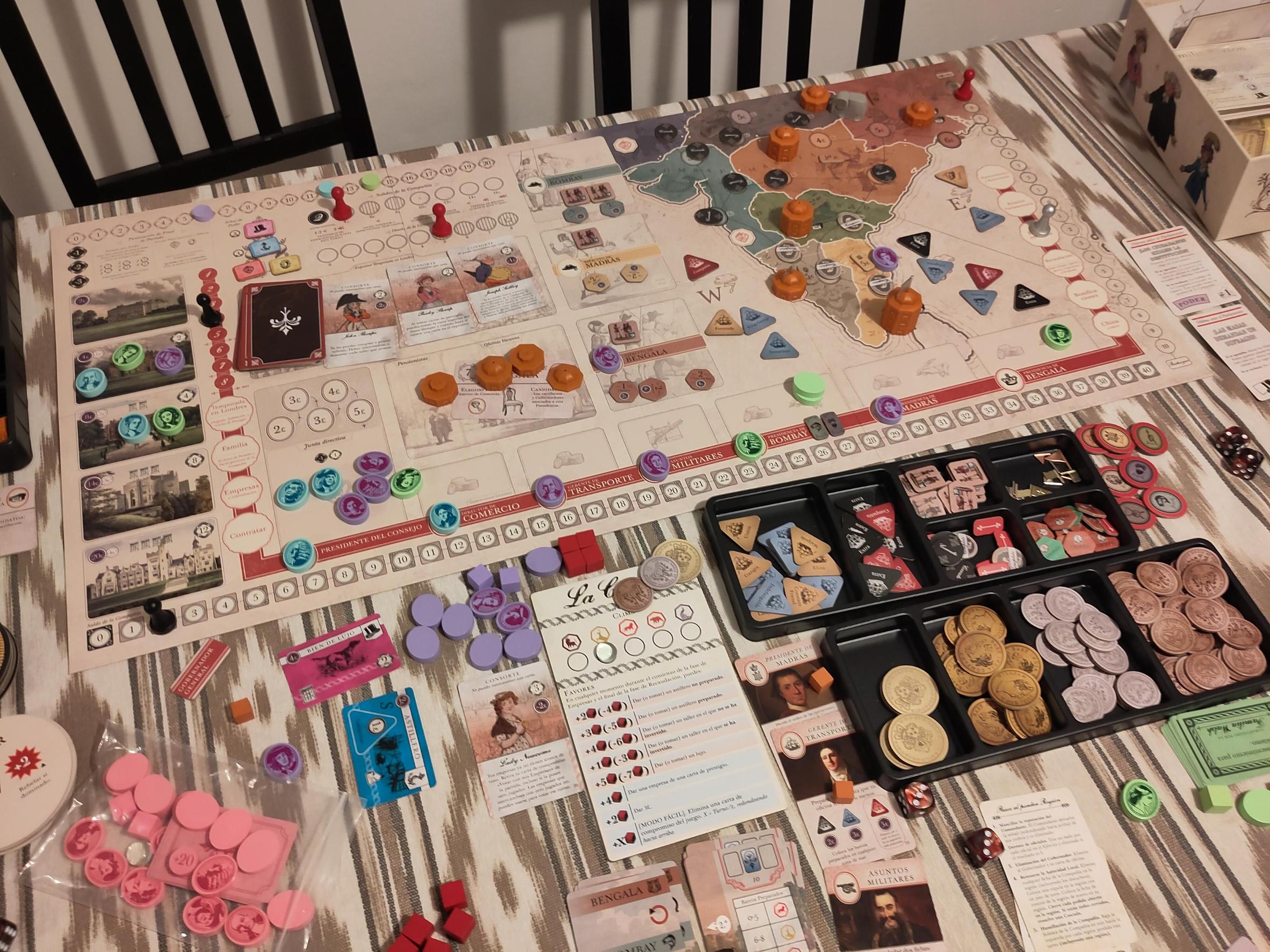
Wo kaufen
Shop-Preise und gebrauchte Exemplare, täglich geprüft.
An Ludoyas Tischen
Alle Statistiken in Ludoya- 166
- Erfasste Partien
- 385
- Spieler
- 3h 44m
- Durchschnittliche Partie
- 93
- In Sammlungen
- 26
- Auf Wunschlisten
6,5/10
aus 38 Ludoya-Rezensionen
Balleflass9,5 Sleeve Kings.
LePois2,5 After playing the game, I saw to major problems. At first, when we got the setup cards, I got the role of PM, money and a boat, am almost zero people in the company. My incentive was then, from the start, to bankrupt the company, but I did not know how to do that for now. As PM, in the first round, I received 3 laws that were against the company, and non of the other 3 players had any incentive of voting them and giving away power to the PM, so I lost my position from the start. That was really off putting, because it was my strongest (and only important) asset, and the chairman got to be PM for the rest of the game. Secondly, after sitting through a game of 3h, without doing much, I was given an opportunity to do something - the other players wanted to get me back in the game, and gave me some positions in the company, and, with the company already heavy in debt, and having another player defecting the company, we formed two teams of 2 players - the ones with major shares and positions in the company, and the ones that wanted to bankrupt the company - if the company is bankrupted, all players with shares at the end of the game (which are points if the company doesn't bankrupt) the points turn into negative points. This was our best bet. And we managed to pull it off, and it seemed that we would be winning (the other player in my team would be 1st, and I would manage to sneak on the 3rd place, with the other players having 2nd place, and 4th place respectively - this last place would have been with zero points). But then there is an extra rule, that activates when the company fails: you have to draw randomly from one of 6 cards. The card drawn stated that all players with shared in the company, would get double the points, basically, to nullify all that we have strived for for the past 2h. The other team got the first two positions, and we got the last two. I get that maybe I shouldn't take this game so seriously, but we spent 7h total (including the teach) playing this. It felt really unfair to pull towards a direction, only to find out at the end that this was never an option, and our struggle was hopeless ... Although I love Pax Pamir, I find the design of JC2 a bit flawed.
andycted9,2 A peculiar game, where you cooperate, but you don't - and in this there's enough meat to make a proper german-loving player go mad. It's basically Republic of Kremlin, reinvented, melted with a lot of new ideas, then polished and infused with plenty of history based mechanisms. Most original game to come out along with splotters in 2020s Update: great even at three players - it becomes a tighter game where you really need to balance everything to survive: the game is murderous ! Basically a different game - and not less enjoyable
Regelfragen
Aus der Spielanleitung beantwortet von Ludoyas Regelassistenten.
Can I spend money from my family treasury to pay for a Company office or action?
No. Cash always has a location: family-treasury cash can pay for family actions, retirements, upkeep, taxes, and negotiations, while cash in a Company office can only be spent by that office. (p. 6)
If I choose the same Family action as last turn, do I get to take it twice?
Yes. If your opportunity marker is already on the action you choose, you take that action twice; choosing a different action lets you take it only once. (p. 13)
What happens when I roll several dice for a Company check?
After applying penalties, roll the dice and use the lowest result: 1–2 is a success, 3–4 is a failure that may be attempted again, and 5–6 is a catastrophic failure that ends the office’s actions and removes its officeholder. (p. 17)
Can a President trade more than once, and can they trade in another President’s home region?
Each President may successfully Trade at most once per turn, and may not fill orders in another President’s home region, even if that Presidency is vacant. Trading must begin from the President’s own home port. (p. 20)
Do local alliances get used up when I buy them, and can I use one for both deploying and defense?
A local alliance can be used for the Deploy action or to defend against threats in India, but each alliance can be used only once on the turn it is purchased, and its strength cannot be split between both purposes. (p. 22)
What happens if the Company cannot afford its expenses during Revenue?
It must take emergency loans until all expenses are paid; each loan adds £5 to the Company Balance and generally increases Company Debt, while also lowering Standing by one space for one or two loans, or two spaces for three or more. Afterward, the Company Balance is set to zero, and Standing is lowered again if the remaining Balance is below Expectations. (p. 27)
Ähnliche Spiele
 John Company2017
 Hegemony: Lead Your Class to Victory2023
 Hegemony: Führe deine Klasse zum Sieg – Erweiterte Ausgabe2023
 The Republic of Rome1990
 Corporate America2013
 Pax Pamir: Second Edition2020
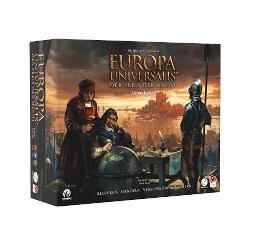 Europa Universalis: Der Preis der Macht (Deluxe Ausgabe)2026
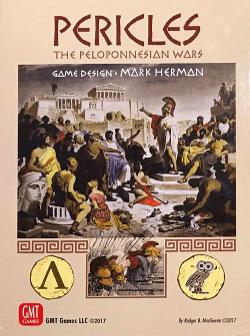 Pericles: The Peloponnesian Wars2017
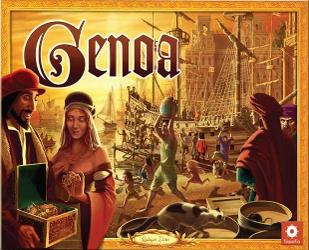 Genoa2009
 Dune2020
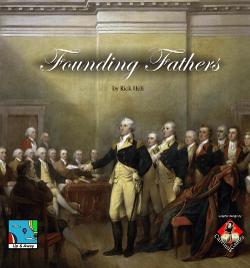 Founding Fathers2007
 Europa Universalis: Der Preis der Macht2026
Wer es hat, hat auch
Pax Pamir: Second Edition2020 Pax Renaissance: 2nd Edition2021
 Horseless Carriage2023
 Oath Reich & Exil: Die Chroniken2022
 Molly House2026
 Napoleon's Triumph: The Battle of Austerlitz, 2 December 18052007
 Pax Porfiriana2012
 Food Chain Magnate2021
 Bus1999
 Weimar: Der Kampf um die Demokratie2023
 Mr. President: The American Presidency, 2001-20202023
 People Power: Insurgency in the Philippines, 1981-19862023
Kostenlos, im Web, für Android und iOS
Spiel John Company: Zweite Auflage mit Ludoya
- Hab es in deiner SammlungVerwalte dein Exemplar und seine Erweiterungen, leih es Freunden oder setz es auf deine Wunschliste und erfahre, wenn der Preis fällt.Zur Sammlung hinzufügen
- Erfasse jede PartiePunkte, Sieger, Timer und Fotos, dann deine Statistiken: Siegquote, liebste Spielerzahl, beste Punktzahl.Partie erfassen
- Regelfragen klärenFrag alles zu den Regeln und erhalte eine Antwort aus der Spielanleitung, mit der Seite zum Nachprüfen.Den Regelassistenten fragen
- Finde Leute, mit denen du es spielstClubs, Spieleabende und Veranstaltungen in deiner Nähe, bei denen dieses Spiel auf den Tisch kommt.Veranstaltungen ansehen
Spieldaten (Spieler, Spielzeit, Alter, Mitwirkende) von BoardGameGeek.