
2011 · Mythologie
Olympos
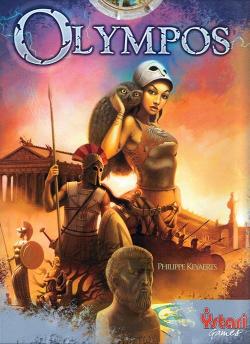
Die Spieler führen eine antike Zivilisation über eine Karte von Griechenland und Atlantis und müssen dabei territoriale Expansion sowie technologische und architektonische Entwicklung ausbalancieren. Aktionen werden ausgeführt, indem man Zeit auf einer gemeinsamen Zeitleiste ausgibt: Durch Vorrücken können Siedler eingesetzt werden, um Gebiete zu erobern und Ressourcen zu sammeln, oder Entdeckungen erworben und Wunder auf einem Entdeckungsplan errichtet werden. Entdeckungen verleihen neue Fähigkeiten (zum Beispiel militärische Verbesserungen), und Wunder bringen Punkte. Gleichzeitig verfolgt eine Frömmigkeitsmechanik die religiöse Gunst und kann Belohnungen oder Bestrafungen durch eine variable Gruppe von Göttern auslösen. Variable Entdeckungskärtchen, Götter und die Kontrolle über die Karte sorgen in jeder Partie für unterschiedliche strategische Entscheidungen. Eine Partie dauert für 2–5 Spieler etwa 60–90 Minuten.
- Spieler
- 2–5 am besten mit 4
- Spielzeit
- 45–90 Min.
- Alter
- 10+
- Komplexität
- 3 / 5
Über das Spiel
- Autoren
- Illustration

Erweiterungen
In Ludoya ansehen
Wo kaufen
Shop-Preise und gebrauchte Exemplare, täglich geprüft.
An Ludoyas Tischen
Alle Statistiken in Ludoya- 21
- Erfasste Partien
- 21
- Spieler
- 1h 35m
- Durchschnittliche Partie
- 13
- In Sammlungen
- 1
- Auf Wunschlisten
7,3/10
aus 5 Ludoya-Rezensionen
Jorge S8,0 Juego ágil y con confrontación. El setup es un poco enfarragoso y los iconos son un poco complicados de entender al principio, pero te deja con ganas de mas y no se hace largo.
Keine Partien protokolliert
Evan7,0 In this game, players place and move discs around a map trying occupy areas that produce the resources that they need to purchase the technology tiles that will grant them abilities and/or points. Player actions are fueled by spending points on the time track. Whichever player has spent the least amount of time overall gets to take the next action. Players can take areas from one another, but the cost in time to do so grows if you don't have more military icons than they do. Losing a region usually isn't a big deal either, as you get a free time point from the supply, and you can walk your disc out of the defeated region at your leisure. Potentially even taking the space right back if you wanted to spend your action that way. The game also features events that will help the players with the most zeus icons, or punish the players with the least. This offers an interesting inventive to jockey for positions, although this does introduce a small element of randomness in a otherwise fairly non random game. The only troublesome random element are the hand cards. When a player crosses an icon on the time track, they get to draw a card to their hand. Some of these cards are played for beneficial effects, others get played for points. Due to luck of the draw, it's possible that one or two players happen to get all the point generating cards, which means they have opportunities for points that other players don't. There is a technology to mitigate that however, turning draw 1 into draw a few choose one, but this aspect is possibly a little troublesome. Overall though, Iove the tension of the game, in terms of who can be the most efficient with the time track, who gets in who's way, and who can be the first to grab that crucial power tile. ★ Art, Iconography and components functional ★ Clever or interesting mechanisms ★ Reasonably low downtime between turns with mildly AP players ★ Multiple plays stay interesting ★ Low or mitigatable luck elements ★★☆☆☆ Raw enjoyment
Erste Eindrücke · 2 Partien


Kostenlos, im Web, für Android und iOS
Spiel Olympos mit Ludoya
- Hab es in deiner SammlungVerwalte dein Exemplar und seine Erweiterungen, leih es Freunden oder setz es auf deine Wunschliste und erfahre, wenn der Preis fällt.Zur Sammlung hinzufügen
- Erfasse jede PartiePunkte, Sieger, Timer und Fotos, dann deine Statistiken: Siegquote, liebste Spielerzahl, beste Punktzahl.Partie erfassen
- Werte ohne PapierNutze die Wertungsbögen und Spielhelfer der Community und lass Ludoya die Punkte zusammenzählen.Wertungsbögen finden
- Finde Leute, mit denen du es spielstClubs, Spieleabende und Veranstaltungen in deiner Nähe, bei denen dieses Spiel auf den Tisch kommt.Veranstaltungen ansehen
Spieldaten (Spieler, Spielzeit, Alter, Mitwirkende) von BoardGameGeek.