
1999 · Transporte
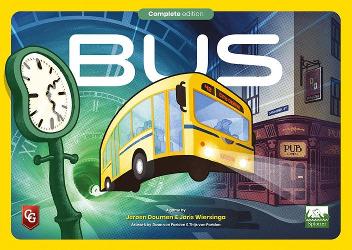
Bus
Los jugadores amplían una red de transporte público e intentan llevar pasajeros a sus destinos a lo largo de una serie de turnos. Cada ronda, los jugadores toman acciones de un tablero de acciones: comprar autobuses adicionales, extender líneas de rutas, introducir nuevos pasajeros mediante trenes, añadir edificios a la ciudad o poner en marcha los autobuses para recoger y puntuar pasajeros. Los tipos de destino cambian con el tiempo (trabajo, bar, casa), así que los jugadores planifican rutas para seguir a los pasajeros a través de necesidades cambiantes. Las extensiones de ruta se conectan a cualquiera de los extremos de las líneas existentes y deben respetar las reglas de colocación; la colocación de edificios puede bloquear o fastidiar las rutas de los oponentes. Algunas acciones tienen un giro de orden de turno: el primer jugador en tomar ciertas acciones las resuelve al final, creando decisiones estratégicas sobre el momento adecuado.
- Jugadores
- 3–5 mejor con 4
- Duración
- 120 min
- Edad
- 14+
- Complejidad
- 3 / 5
Sobre el juego
- Publisher




Fotos de mesas de Ludoya
Todas las fotos en LudoyaDónde comprarlo
Precios de tiendas y copias de segunda mano, revisados cada día.
En las mesas de Ludoya
Todas las estadísticas en Ludoya- 144
- Partidas registradas
- 309
- Jugadores
- 1h 16m
- Partida media
- 53
- En colecciones
- 22
- En listas de deseos
7,6/10
de 30 reseñas en Ludoya
Amy7,8 Me ha gustado mucho, es un juego muy cabron que te invita a hacer daño a los demás y hacer que pierdan acciones, la duración de la partida y el diseño están ways, he disfrutado la partido mucho y me gustaría volver a jugarlo
Oscaarz6,0 Assez plaisant, 90 minutes avec 5 joueurs meme si 1er partie. J'aime bien le theme du transport en commun. A réessayer!
Evan7,2 This is a route building, pickup and deliver game by splotter, that has a somewhat similar feel to Food Chain Magnate, in that it's completely brutal and unforgiving of the smallest mistake. Each player gets a limited supply of action cubes, that when spent, are gone forever. Only one player having action cubes left is one of the endgame timers. You place cubes into an action board, which allows you to expand your route, deliver more people with a single action, place people who want to travel, place buildings for the people to travel to, move people, become first player, or halt the shifting of where the people want to go to. During the movement phase, the meeples will be available to travel if they aren't currently at an intersection where the place everyone wants to go to is. Not only that, but if a place like that is at their intersection, they take that place out of contention as well. This means that the places available and the meeples available to work with is surprisingly limited, and points are extremely tight. I found this game fascinating, and it did play a lot shorter than most Splotter games I've tried. :star: Art, Iconography and components functional :star: Clever or interesting mechanisms :star: Reasonably low downtime between turns with mildly AP players :star: Multiple plays stay interesting :star: Low or mitigatable luck elements :star::star::nostar::nostar::nostar: Raw enjoyment


Dudas de reglas
Respondidas a partir del reglamento por el asistente de reglas de Ludoya.
How many actions do I have to choose each round — do I have to pick exactly two or can I pick more?
You must choose at least two actions each round, but you may choose more up to the number of action stones you have remaining; some actions (buying a bus, clock, starting player) can be taken by only one player that round and other actions can be chosen by multiple players (page 2).
What is the “maximum number of buses” and why does it matter?
The maximum number of buses is the number of buses owned by the player who has the most buses, and it immediately determines how many passengers, line expansions and buildings players must add when those actions are taken (page 2).
When am I allowed to expand my line parallel to someone else’s line?
You may only build parallel in two cases: (1) if no empty streets are available at your head you may continue parallel until you reach an empty street, or (2) if your head is on the same crossing as another player's head (and all players with lines on that stretch also have their heads there), you may build parallel until the next crossing where you must take an empty street if available (page 3).
If I close a circle with my line, where are my line’s heads and how do I show them?
When you close a circle the line’s heads remain at the crossing where the circle was closed (giving you two heads there), and you must place the involved action stone on that crossing so everyone can see from which point you must connect next round (page 3).
How does Vrrooomm! (moving buses) work — which passengers can I move and where can I place them?
Each bus can carry one passenger; you may only transport passengers who ‘want to get away’ (i.e., are dissatisfied with the building on their crossing) and you must place them into an empty building of the correct type that lies on your own line, scoring one point per passenger moved (page 5).
What happens if I choose to stop time with the clock action?
If you stop time you take one clock stone (which counts as one minus point) and the time indicator stays where it is; if the last clock stone is taken the time-space-continuum ruptures and the game ends immediately with immediate scoring — further actions in that round are not played (page 5).
Juegos similares
 Mistwind2024
 On the Underground: Paris / New York2024
 On the Underground: London / Berlin2019
 Railroad Tycoon: The Boardgame2005
 Silverton1991
 Caylus2012
 Roads & Boats: 20th Anniversary Edition2019
 Raíles: Millonarios del Vapor2009
 Maglev Metro2022
 Wasteland Express Delivery Service2019
 Baltimore & Ohio2009
 Cross Bronx Expressway2025
Quien lo tiene también tiene









Gratis, en web, Android e iOS
Juega a Bus con Ludoya
- Tenlo en tu colecciónControla tu copia y sus expansiones, préstala a tus amigos o ponla en tu lista de deseos y te avisamos cuando baje de precio.Añadirlo a tu colección
- Registra cada partidaPuntuaciones, ganadores, temporizadores y fotos, y luego tus estadísticas: porcentaje de victorias, número de jugadores favorito, mejor puntuación.Registrar una partida
- Resuelve dudas de reglasPregunta lo que quieras sobre las reglas y obtén una respuesta sacada del reglamento, con la página donde comprobarla.Preguntar al asistente de reglas
- Encuentra gente con quien jugarloClubes, noches de juegos y eventos cerca de ti que sacan este juego a la mesa.Ver eventos
Datos del juego (jugadores, duración, edad, créditos) de BoardGameGeek.