
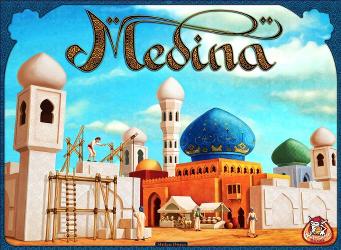
2014 · Construction de villes
Medina (Second Edition)
Players rebuild a North African medina in 1822 by placing wooden pieces to erect palaces, expand the market, and repair the city walls. Each turn a player places two pieces (or skips placement with a tea tile), adding to existing colored buildings or starting new ones, and expanding shared features like the well and walls that grow from the board corners. Scoring awards points for claimed buildings (one point per attached piece), majority bonuses for the largest building in each color, rewards for palaces around the well, and a bonus for the player who most recently connected a building to the walls. The game uses many detailed wooden components and a double-sided board for variable player counts.
- Joueurs
- 2–4 idéal à 4
- Temps de jeu
- 60 min
- Âge
- 10+
- Complexité
- 2,4 / 5
À propos du jeu
- Auteurs
- Illustration


Extensions
Les voir dans Ludoya
Sur les tables de Ludoya
Toutes les statistiques dans Ludoya- 38
- Parties enregistrées
- 47
- Joueurs
- 1h 12m
- Partie moyenne
- 12
- Dans des collections
- 8
- Dans des listes de souhaits
5,0/10
sur 13 avis Ludoya
Garfield7,0 #31 Beautiful looking game with interesting decisions to make. [c] Theme: ★☆☆☆☆ <!-- size 7]Very little, very abstract --> Gameplay: ★★★☆☆ <!-- size 7]Playing different tiles --> Interaction: ★★★★★ <!-- size 7]Who plays where and claims a palace --> Artwork: ★★★☆☆ <!-- size 7]Only the board has artwork --> Luck: ★☆☆☆☆ <!-- size 7]No luck involved --> Strategy: ★★★★☆ <!-- size 7]When and where to claim --> Components: ★★★★☆ <!-- size 7]Beautiful wooden (but cheap wood) components --> Play duration: ★★★★★ <!-- size 7]Perfect (78min) --> Easy to teach: ★★★★☆ <!-- size 7]Quite easy (15min) --> Rules quality: ★★★★☆ <!-- size 7]Very good --> Setup time: ★★★★☆ <!-- size 7]Fast --> No downtime: ★★★☆☆ <!-- size 7]Little Downtime --> Replay value: ★★☆☆☆ <!-- size 7]Not much variety --> [/c]
Evan2,5 In this game everyone gets an even share of bricks in each of the four colors, and an even share of the neutral colored pieces and a set of four player colored claim markers. On your turn you place 2 of your pieces. Once a player uses one of their two placements to put down a claim marker on a contiguous blob of colored bricks, the structure can no longer be added to by any player and that player can no longer claim a structure of that color. In this way players slowly build the board up. Essentially, it's an abstract push your luck game. Do you money up an area or claim it for yourself? There are some interesting placement rules such as two blobs of bricks can never touch each other, even via diagonals, which means the first few rounds things feel uselessly empty, and in the last few rounds things are claustrophobicly tight. The neutral pieces are also interesting because they too have specific placement rules, and they essentially money up bricks they are next to. So, claim things too early, and someone will beat you out for the 'most bricks of X color' tile, and make sure your stuff isn't near the neutral scoring pieces. Claim things too late, and you'll be severely limited by space and other players aggressive moves to clog your area. This game winds up being fairly AP heavy since it's both mathy and players don't get much to go on in terms of how to value things. It also doesn't feel very satisfying since it's going to usually be other people claiming your work, and you claiming their work. It's a game where it seems like it feels like things just happen and you hope for the best and your success or failure relies heavily on the player to your right setting you up more than the player to their right set them up. ★ Art, Iconography and components functional ★ Clever or interesting mechanisms ☆ Reasonably low downtime between turns with mildly AP players ☆ Multiple plays stay interesting ☆ Low or mitigatable luck elements ★★☆☆☆ Raw enjoyment

Ceux qui l'ont possèdent aussi


Gratuit, sur le web, Android et iOS
Jouez à Medina (Second Edition) avec Ludoya
- Gardez-le dans votre collectionSuivez votre exemplaire et ses extensions, prêtez-le à vos amis ou ajoutez-le à votre liste de souhaits et soyez prévenu quand le prix baisse.Ajouter à votre collection
- Enregistrez chaque partieScores, gagnants, minuteurs et photos, puis vos statistiques : taux de victoire, nombre de joueurs préféré, meilleur score.Enregistrer une partie
- Comptez les points sans papierUtilisez les feuilles de score et les aides de jeu de la communauté, et laissez Ludoya additionner les points.Trouver des feuilles de score
- Trouvez des gens avec qui y jouerClubs, soirées jeux et événements près de chez vous qui mettent ce jeu sur la table.Voir les événements
Données du jeu (joueurs, durée, âge, crédits) issues de BoardGameGeek.