
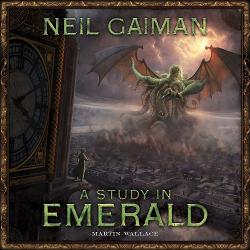
2015 · Baseado em um romance
A Study in Emerald (Second Edition)
It is 1882 and ancient cosmic rulers quietly dominate society while a secret civil war simmers between their loyalists and underground revolutionaries. Players control Victorian agents, recruiting allies, placing influence in cities and carrying out covert actions as loyalties remain hidden. Gameplay mixes area control, asymmetric objectives and card-driven resolution: players draft and play character cards, move and clash over locations, resolve assassinations and revolts, and manage shifting public order. The outcome depends on deduction, timing and whether a player furthers the restoration or defends the Old Ones’ rule.
- Jogadores
- 2–5 melhor com 5
- Tempo de jogo
- 60 min
- Idade
- 13+
- Complexidade
- 2,9 / 5
Sobre o jogo
- Design
- Arte
- Publisher



Onde comprar
Preços das lojas e cópias usadas, verificados todos os dias.
- ZacatrusSem estoque40.45 €
- Dungeon MarvelsPré-venda42.75 €
- Juegos de la Mesa RedondaSem estoque40.46 €
- SpielezarSem estoque72.9 Fr.
Nas mesas da Ludoya
Todas as estatísticas na Ludoya- 90
- Partidas registradas
- 158
- Jogadores
- 2h 1m
- Partida média
- 40
- Em ludotecas
- 3
- Em listas de desejos
4,4/10
de 22 avaliações na Ludoya
Evan2,5 A Study In Emerald first edition is currently my favorite game. After reading about the changed they made to second edition, I had avoided it up until now, but this week I was given the opportunity to actually try it so I thought I should. In the game, players use a deck-building mechanism to place cubes into the various spots on the board. if at the start of your turn, you have the most components in that spot, you can take the top card of the pile and add it to your deck. I absolutely love this mechanism. Players also have a secret alignment, although they still win the game alone. If at the end of the game, you wind up on the same team as the player with the fewest points, there is a penalty. I do love being able to be out for myself but also being required to look at my opponent's moves to predict what team they might be on. All of this is true in both the first and second edition of the games. Speaking to the second edition specifically, I have some problems. In both games, there is a mechanism where players can hire agents. These are markers on the board that you can move from city to city, which are a requirement for certain actions, but more specifically they add claim to any space where you have cubes down to bid for a card. In first edition, you pay to walk these agents around the map, and the card icons you use to move them are the same that you use to buy new claim cubes, so there's a semi-predictable flow to when someone is getting ready to move. In addition, they also break ties when it comes to situations where two players have equal claim on a card. In second edition, the agents can teleport anywhere by spending a card icon that is used exclusively for teleporting agents. In addition, while they still count for claim they no longer break ties. The result of this in our game was that cards on top of piles got caught into unbreakable stale mates more easily, which hurt the players involved substantially as the game length was reduced. Another issue I ran into was that points are uncomfortably rare. In first edition, players vie for control of city cards, handing them back and forth, gaining or losing points while fighting for whatever points they can gather from permanent sources. These city cards are always available in addition to whatever is on the top of the card piles. In second edition, the cards worth points don't get handed back and forth, they are simply claimed by whomever gets it and that's it. Not only that, they are not always available, as they just get shuffled into the piles and come up when they come up. This makes for a boom-and-bust feeling as some rounds there are lots of points to fight for and other rounds it feels like there's nothing to fight for. The third big problem I have is that the endgame penalty is different. In the first edition, if you were on the same team as the player in last you automatically are disqualified from winning. In second edition, the players on the same team merely lose 5 points. This means that in second edition, you don't really have to care who your teammates are before initiating the end of the game. Again, the game time is so reduced that spending actions bluffing your faction seems senseless. All in all, I wouldn't go so far as to say second edition is a bad game in the spectrum of board games that exist, but much of what I love about first edition is absent or changed, and I can't imagine recommending someone get this as opposed to hunting down a first edition copy. :star: Art, Iconography and components functional :nostar: Clever or interesting mechanisms :star: Reasonably low downtime between turns with mildly AP players :star: Multiple plays stay interesting :star: Low or mitigatable luck elements :nostar::nostar::nostar::nostar::nostar: Raw enjoyment
Mestremuten7,0 Rating: 3/5 Production value: 3/4 Is the game in my collection/Love to have?: 1/1
Really cool game with awesome theme that combines deck building, bidding and partnership. A bit short for me and needs 3-4 players to work.

Jogos semelhantes
 A Study in Emerald2013
 Cthulhu: Dark Providence2026
 Nightfall: The Coldest War2012
 Wonderland's War2024
 Marvel Zombies: X-Men Resistance2023
 Last Night on Earth: The Zombie Game – 10 Year Anniversary Edition2017
 Legendary: A James Bond Deck Building Game2019
 I, Spy2015
 Mind MGMT: O "Jogo" de Espionagem Psíquica2024
 The Presence2025
 Army of the Dead: A Zombicide Game2024
 Zombicide Season 2: Prison Outbreak2013


Grátis, na web, Android e iOS
Jogue A Study in Emerald (Second Edition) com a Ludoya
- Tenha na sua ludotecaAcompanhe sua cópia e suas expansões, empreste para os amigos ou coloque na lista de desejos e seja avisado quando o preço cair.Adicionar à sua ludoteca
- Registre cada partidaPontuações, vencedores, cronômetros e fotos, e depois suas estatísticas: taxa de vitórias, número de jogadores favorito, melhor pontuação.Registrar uma partida
- Marque os pontos sem papelUse as folhas de pontuação e os ajudantes de jogo da comunidade e deixe a Ludoya somar os pontos.Encontrar folhas de pontuação
- Encontre gente para jogarClubes, noites de jogos e eventos perto de você que levam este jogo para a mesa.Ver eventos
Dados do jogo (jogadores, tempo de jogo, idade, créditos) do BoardGameGeek.