
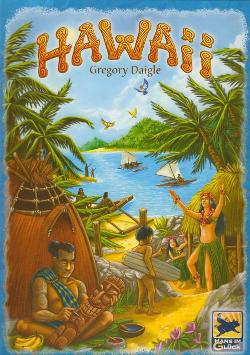
2011 · Gebietsaufbau
Hawaii
Die Spieler schlüpfen in die Rolle von Stammesoberhäuptern, die über fünf Runden Küstendörfer ausbauen und benachbarte Inseln erkunden. Die Bewegung auf einem modularen Spielplan erlaubt es den Häuptlingen, neue Dorffelder zu kaufen, drei verschiedene Währungen zu verwalten, um Reisen zu bezahlen, und ihre Siedlungen zu vergrößern. Das Einkommen sinkt im Verlauf des Spiels, daher müssen die Spieler kurzfristige Käufe, die ihrem Volk gefallen, mit langfristiger Plazierung von Plättchen und Inselerkundung abwägen, um Punkte zu sammeln. Das Spiel legt den Schwerpunkt auf Ressourcenmanagement, räumliche Planung der Dorffelder und das richtige Timing der Aktionen, um die Gegner bei den besten Geschäften auszustechen.
- Spieler
- 2–5 am besten mit 3
- Spielzeit
- 60 Min.
- Alter
- 13+
- Komplexität
- 2,9 / 5
Über das Spiel
- Autoren
- Illustration
- Publisher


Erweiterungen
In Ludoya ansehen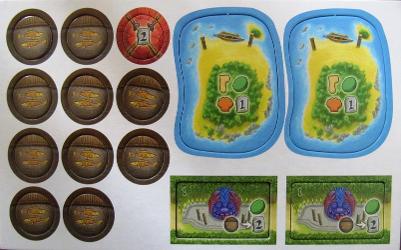
An Ludoyas Tischen
Alle Statistiken in Ludoya- 40
- Erfasste Partien
- 50
- Spieler
- 1h 32m
- Durchschnittliche Partie
- 17
- In Sammlungen
- 3
- Auf Wunschlisten
5,2/10
aus 15 Ludoya-Rezensionen
Evan4,6 At the start of each round, action tokens are distributed from a bag to the spaces in the action areas. Each token has a number representing the cost of that action in shell tokens. This process is a little fiddly, since first you fill some spaces, then come back and start from the top filling the rest so long as a math equation comparing the sums of tokens lines up. It's mildly annoying to have to start each round this way. Then players in turn order can spend feet tokens to walk their action pawn to a space with an action token. Claim that token, pay the cost, and resolve the action. The cost is one foot per tile. They can also pay twice as much as the cost token to gain an extra effect. Claimed tokens go in front of you, and at the end of the round there's a check to see if players picked up enough tokens so the sum at least hits the stated amount on the round indicator, and then there's a majority scoring for who got the highest sum of tokens. The intent being that there's some tension between wanting to spend double for the extra effect, but then that will hurt your end of round majority chances. Really though, the game is restrictive to the point of feeling a little dull. To make the end of round scoring you are pressured to overspend. Action tokens are very limited, with randomly determined boom and bust rounds depending on what price ends ups where and how many tokens make it into any given space. Most of the actions get you a tile to add to your board. Generally, the two paths through the game are to go for lots of tiles in the same row or trying to get something to score in all your rows to hit the maximum bonus threshold. It's fine, but feels needlessly limited in the face of similar games like Yokohama. :star: Art, Iconography and components functional :star: Clever or interesting mechanisms :star: Reasonably low downtime between turns with mildly AP players :star: Multiple plays stay interesting :star: Low or mitigatable luck elements :star::star::nostar::nostar::nostar: Raw enjoyment
Regelfragen
Aus der Spielanleitung beantwortet von Ludoyas Regelassistenten.
Do I have to pay movement cost every time my chieftain moves, and what pays for it?
Yes — when you move a chieftain you pay the printed movement cost using the movement currency (feet/shells) as explained in the movement rules and examples (see pp. 5–6).
When I buy a place tile, do I pay the printed price or the price token, and where do I place the tile?
You pay the current price shown for that place (follow the rules for price tokens vs. printed numbers) and then place the purchased place tile according to the placement rules in the buy/place section (see pp. 4, 6–7).
How do Fishing Cove and the Island Dock work — do I have to pay feet to take fish, and how do boats affect this?
Visits to the Fishing Cove and Island Dock follow their specific rules: you take fish or use boat effects as described and pay any required feet when indicated; boat usage, scoring, and island-stack handling are covered with examples (see p. 8).
Why do we put chieftains on the player sequence track and how does that affect end-of-round scoring?
Placing chieftains on the sequence track sets turn order and determines positions used for end-of-round scoring; the rulebook gives the placement procedure and scoring examples so you resolve ties and scoring correctly at round end (see p. 9).
What happens between rounds — are resources refilled and how are place tiles/islands reset?
At round preparation you distribute shells/feet/fruits, handle place-tile replenishment, replace the round indicator, reset tokens and islands, and then start the next round as detailed in the round-prep steps (see p. 10).






Kostenlos, im Web, für Android und iOS
Spiel Hawaii mit Ludoya
- Hab es in deiner SammlungVerwalte dein Exemplar und seine Erweiterungen, leih es Freunden oder setz es auf deine Wunschliste und erfahre, wenn der Preis fällt.Zur Sammlung hinzufügen
- Erfasse jede PartiePunkte, Sieger, Timer und Fotos, dann deine Statistiken: Siegquote, liebste Spielerzahl, beste Punktzahl.Partie erfassen
- Regelfragen klärenFrag alles zu den Regeln und erhalte eine Antwort aus der Spielanleitung, mit der Seite zum Nachprüfen.Den Regelassistenten fragen
- Finde Leute, mit denen du es spielstClubs, Spieleabende und Veranstaltungen in deiner Nähe, bei denen dieses Spiel auf den Tisch kommt.Veranstaltungen ansehen
Spieldaten (Spieler, Spielzeit, Alter, Mitwirkende) von BoardGameGeek.