
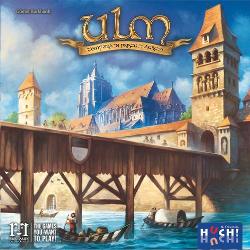
2016 · Medieval
Ulm
Los jugadores amplían su influencia en una próspera ciudad imperial libre de principios del siglo XVI mientras se construye la catedral. En cada turno, se introduce una única loseta de acción en una cuadrícula catedralicia de 3x3 para realizar las tres acciones vinculadas que activa, como comerciar con mercancías, contratar artesanos, adquirir influencia con gremios y patricios, y hacer avanzar la torre de la catedral. La partida dura un número fijo de rondas; los jugadores gestionan recursos, tiempo y colocación de trabajadores para conseguir puntos de victoria en las áreas del mercado, la artesanía y la vida cívica. Gana el jugador que tenga más puntos cuando se complete la catedral.
- Jugadores
- 2–4 mejor con 3
- Duración
- 45–75 min
- Edad
- 10+
- Complejidad
- 2,7 / 5
Sobre el juego
- Diseño
- Arte
Fotos de mesas de Ludoya
Todas las fotos en Ludoya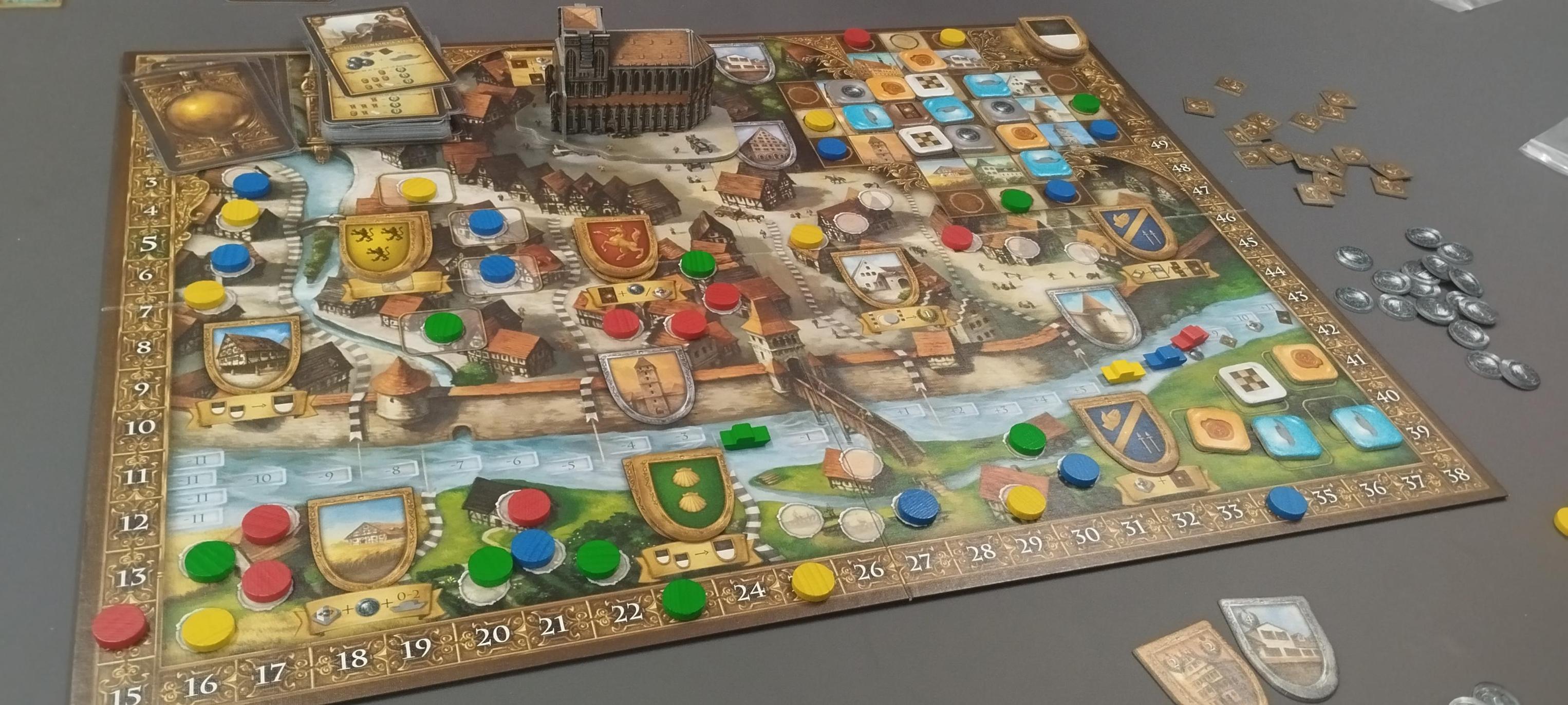
Dónde comprarlo
Precios de tiendas y copias de segunda mano, revisados cada día.
En las mesas de Ludoya
Todas las estadísticas en Ludoya- 101
- Partidas registradas
- 99
- Jugadores
- 1h 22m
- Partida media
- 19
- En colecciones
- 3
- En listas de deseos
4,6/10
de 19 reseñas en Ludoya
Evan2,5 Ulm felt like it could have been a great game. interesting action selection mechanism, players claiming areas so they get a benefit when someone else resolves an action... Unfortunately it fell flat mostly due to randomness. Annoyingly, the rulebook is split across two books for no reason. This makes looking things up a challenge. Then, the basic mechanism of the game is, draw a tile, push it into a row, resolve the 3 central actions in any order of your row including the tile you pushed in. You start the game with 1 tile in your "supply" one might imagine this means you draw a tile, add it to your hand, then choose a tile from your hand and push it in. Unfortunately, the rules state you must push in the tile you drew that turn, so you get to know what 2 of your 3 actions are and the third is totally random. The tiles in your supply are used only for discarding to pay for the effect of, or to acquire cards. The cards when played have a choice of giving you an immediate effect or adding them to end of game scoring sets. Of course, getting and playing these cards requires some luck in terms of what tile effect you are able to activate. One of the actions is a seal, which lets you place a marker either above or below your boat along the river. This is an interesting limitation on your actions, because you want to move the boat along the river, because that's where points are, but the further you go the more actions are no longer available to you. Here's the problem. The actions above and below the river are what get claimed by players. One of the river abilities is to randomly draw 2 location tiles keep one. About half of them are one and done score points, the other half let you claim locations. So maybe you draw the location that's at the start of the river late in the game when nobody can resolve that action anymore. The game does have some luck mitigation. Most things are draw 2 keep 1 and there are ability tiles that can mitigate some of the luck. There are also sparrow tokens worth 1vp each if unspent, that can be spent to let you swap your draw with one from a faceup market display. The question is, how many times do you spend 1vp to swap your useless draw for an ok tile before the market is full of garbage and you are out of 1vp tiles? :nostar: Art, Iconography and components functional :star: Clever or interesting mechanisms :star: Reasonably low downtime between turns with mildly AP players :star: Multiple plays stay interesting :nostar: Low or mitigatable luck elements :star::nostar::nostar::nostar::nostar: Raw enjoyment
Garfield5,0 #AreaControl #SetCollecting Themeless and pretty much luckbased. [c] Theme: :star::nostar::nostar::nostar::nostar: <!-- size 7]Not really --> Gameplay: :star::star::nostar::nostar::nostar: <!-- size 7]Slightly boring --> Interaction: :star::nostar::nostar::nostar::nostar: <!-- size 7]Nope --> Artwork: :star::star::nostar::nostar::nostar: <!-- size 7]Nothing special --> Luck: :star::star::star::star::nostar: <!-- size 7]Card drawing luck, tile drawing luck --> Strategy: :star::star::nostar::nostar::nostar: <!-- size 7]Little --> Components: :star::star::star::nostar::nostar: <!-- size 7]Good --> Play duration: :star::star::star::nostar::nostar: <!-- size 7]Ok, but could be shorter --> Easy to teach: :star::star::nostar::nostar::nostar: <!-- size 7]A lot of actions to explain --> Setup time: :star::star::star::star::nostar: <!-- size 7]Quick --> No downtime: :star::star::star::nostar::nostar: <!-- size 7]Little to huge --> [/c]
Dudas de reglas



Gratis, en web, Android e iOS
Juega a Ulm con Ludoya
- Tenlo en tu colecciónControla tu copia y sus expansiones, préstala a tus amigos o ponla en tu lista de deseos y te avisamos cuando baje de precio.Añadirlo a tu colección
- Registra cada partidaPuntuaciones, ganadores, temporizadores y fotos, y luego tus estadísticas: porcentaje de victorias, número de jugadores favorito, mejor puntuación.Registrar una partida
- Puntúa sin papelUsa las hojas de puntuación y ayudas de juego de la comunidad, y deja que Ludoya sume los puntos.Buscar hojas de puntuación
- Encuentra gente con quien jugarloClubes, noches de juegos y eventos cerca de ti que sacan este juego a la mesa.Ver eventos
Datos del juego (jugadores, duración, edad, créditos) de BoardGameGeek.