
2010 · Économique
Firenze
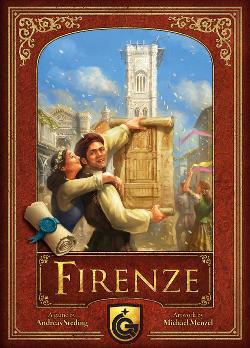
Players act as master builders in medieval Florence, accepting commissions from wealthy families and the church to construct square-based tower homes as status symbols. Gameplay uses colored bricks as currency and a shared card display: on a turn a player takes a card to gain its bricks, pays a brick for each skipped card, and may exchange three bricks for a displayed one before working on their building sites. Multiple towers can be underway, but adding bricks costs more per brick and any tower not built on during a turn is torn down as abandoned construction. Players score by completing commissions and placing seals; when a player places their final seal the others get one last turn before final scoring.
- Joueurs
- 2–4 idéal à 3
- Temps de jeu
- 60 min
- Âge
- 12+
- Complexité
- 2,5 / 5
À propos du jeu
- Auteurs
- Illustration

Extensions
Les voir dans Ludoya
Où l'acheter
Prix des boutiques et exemplaires d'occasion, vérifiés chaque jour.
Sur les tables de Ludoya
Toutes les statistiques dans Ludoya- 122
- Parties enregistrées
- 132
- Joueurs
- 1h 16m
- Partie moyenne
- 26
- Dans des collections
- 4
- Dans des listes de souhaits
6,3/10
sur 14 avis Ludoya
Evan5,9 The general idea here is that there is a conveyor belt of powerful cards, each has four random colorful tower pieces placed on it. On your turn, you select a card from the row that you want, paying a tower piece to each card along the belt as you travel from oldest to newest card. Then you take the card, and collect all the pieces on the card. After resolving the card, you can build stacks of tower pieces, and then chose to complete one of the towers, which is how you actually score. Players compete to be the first to score each height requirement for each of the different colors. Then there are bonus points for having the most levels on each color of tower. The real beauty of the game is that many cards actually have negative effects for the player who takes them, but as players skip over them they become more and more lucrative. :star: Art, Iconography and components functional :star: Clever or interesting mechanisms :star: Reasonably low downtime between turns with mildly AP players :nostar: Multiple plays stay interesting :star: Low or mitigatable luck elements :star::star::star::nostar::nostar: Raw enjoyment






Gratuit, sur le web, Android et iOS
Jouez à Firenze avec Ludoya
- Gardez-le dans votre collectionSuivez votre exemplaire et ses extensions, prêtez-le à vos amis ou ajoutez-le à votre liste de souhaits et soyez prévenu quand le prix baisse.Ajouter à votre collection
- Enregistrez chaque partieScores, gagnants, minuteurs et photos, puis vos statistiques : taux de victoire, nombre de joueurs préféré, meilleur score.Enregistrer une partie
- Comptez les points sans papierUtilisez les feuilles de score et les aides de jeu de la communauté, et laissez Ludoya additionner les points.Trouver des feuilles de score
- Trouvez des gens avec qui y jouerClubs, soirées jeux et événements près de chez vous qui mettent ce jeu sur la table.Voir les événements
Données du jeu (joueurs, durée, âge, crédits) issues de BoardGameGeek.