
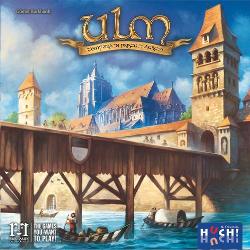
2016 · Medievale
Ulm
I giocatori espandono la propria influenza in una prospera città imperiale libera dell'inizio del XVI secolo, mentre la cattedrale è in costruzione. A ogni turno, una tessera azione viene spinta in una griglia 3x3 della cattedrale per eseguire le tre azioni collegate che attiva, come commerciare merci, assumere artigiani, acquisire influenza presso corporazioni e patrizi e far avanzare la torre della cattedrale. La partita si svolge in un numero fisso di round; i giocatori gestiscono risorse, tempo e piazzamento dei lavoratori per ottenere punti vittoria nei settori del mercato, dell'artigianato e della città. Vince il giocatore con più punti al completamento della cattedrale.
- Giocatori
- 2–4 ideale in 3
- Tempo di gioco
- 45–75 min
- Età
- 10+
- Complessità
- 2,7 / 5
Il gioco
- Autori
- Illustrazioni
Foto dai tavoli di Ludoya
Tutte le foto in Ludoya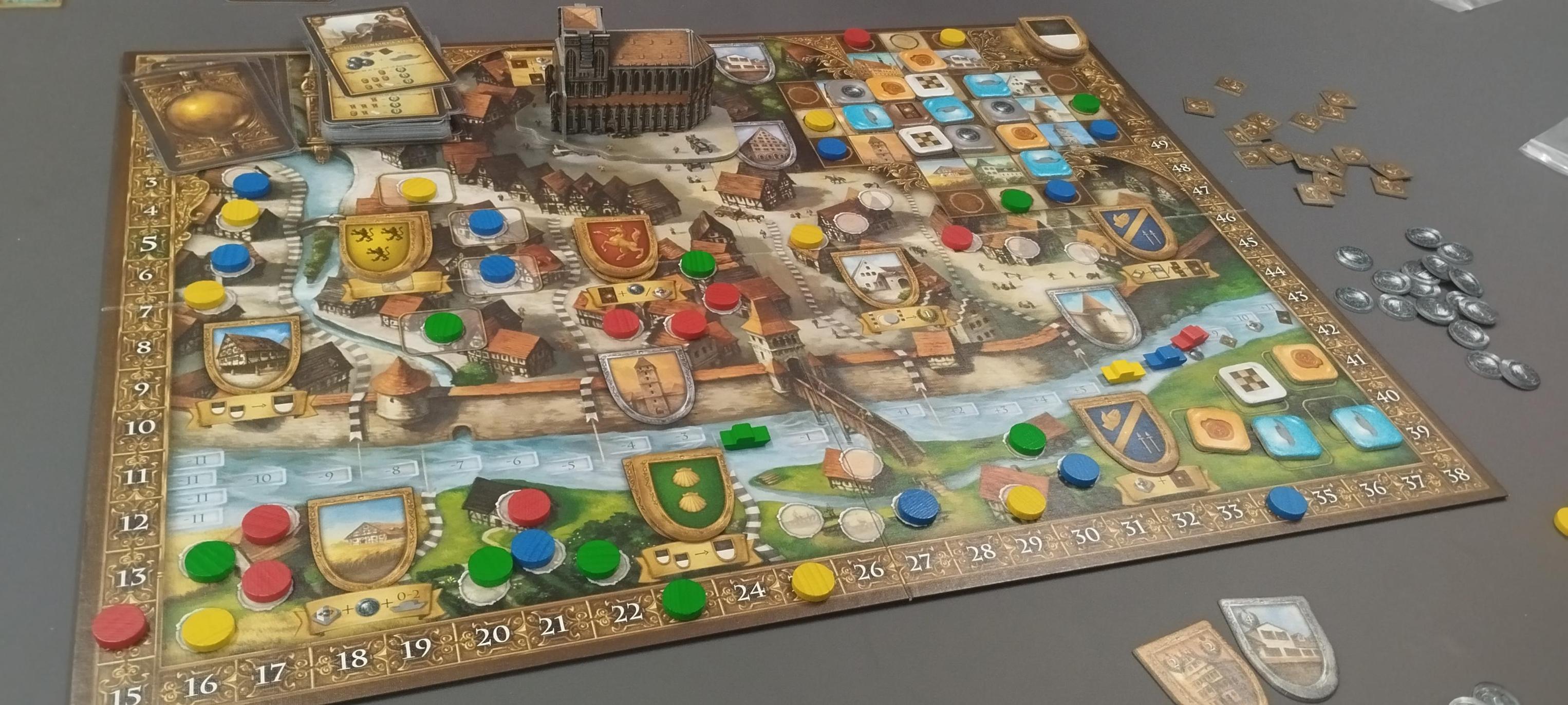
Dove comprarlo
Prezzi dei negozi e copie usate, controllati ogni giorno.
Sui tavoli di Ludoya
Tutte le statistiche in Ludoya- 101
- Partite registrate
- 99
- Giocatori
- 1h 22m
- Partita media
- 19
- Nelle ludoteche
- 3
- Nelle liste dei desideri
4,6/10
da 19 recensioni Ludoya
Evan2,5 Ulm felt like it could have been a great game. interesting action selection mechanism, players claiming areas so they get a benefit when someone else resolves an action... Unfortunately it fell flat mostly due to randomness. Annoyingly, the rulebook is split across two books for no reason. This makes looking things up a challenge. Then, the basic mechanism of the game is, draw a tile, push it into a row, resolve the 3 central actions in any order of your row including the tile you pushed in. You start the game with 1 tile in your "supply" one might imagine this means you draw a tile, add it to your hand, then choose a tile from your hand and push it in. Unfortunately, the rules state you must push in the tile you drew that turn, so you get to know what 2 of your 3 actions are and the third is totally random. The tiles in your supply are used only for discarding to pay for the effect of, or to acquire cards. The cards when played have a choice of giving you an immediate effect or adding them to end of game scoring sets. Of course, getting and playing these cards requires some luck in terms of what tile effect you are able to activate. One of the actions is a seal, which lets you place a marker either above or below your boat along the river. This is an interesting limitation on your actions, because you want to move the boat along the river, because that's where points are, but the further you go the more actions are no longer available to you. Here's the problem. The actions above and below the river are what get claimed by players. One of the river abilities is to randomly draw 2 location tiles keep one. About half of them are one and done score points, the other half let you claim locations. So maybe you draw the location that's at the start of the river late in the game when nobody can resolve that action anymore. The game does have some luck mitigation. Most things are draw 2 keep 1 and there are ability tiles that can mitigate some of the luck. There are also sparrow tokens worth 1vp each if unspent, that can be spent to let you swap your draw with one from a faceup market display. The question is, how many times do you spend 1vp to swap your useless draw for an ok tile before the market is full of garbage and you are out of 1vp tiles? :nostar: Art, Iconography and components functional :star: Clever or interesting mechanisms :star: Reasonably low downtime between turns with mildly AP players :star: Multiple plays stay interesting :nostar: Low or mitigatable luck elements :star::nostar::nostar::nostar::nostar: Raw enjoyment
Garfield5,0 #AreaControl #SetCollecting Themeless and pretty much luckbased. [c] Theme: :star::nostar::nostar::nostar::nostar: <!-- size 7]Not really --> Gameplay: :star::star::nostar::nostar::nostar: <!-- size 7]Slightly boring --> Interaction: :star::nostar::nostar::nostar::nostar: <!-- size 7]Nope --> Artwork: :star::star::nostar::nostar::nostar: <!-- size 7]Nothing special --> Luck: :star::star::star::star::nostar: <!-- size 7]Card drawing luck, tile drawing luck --> Strategy: :star::star::nostar::nostar::nostar: <!-- size 7]Little --> Components: :star::star::star::nostar::nostar: <!-- size 7]Good --> Play duration: :star::star::star::nostar::nostar: <!-- size 7]Ok, but could be shorter --> Easy to teach: :star::star::nostar::nostar::nostar: <!-- size 7]A lot of actions to explain --> Setup time: :star::star::star::star::nostar: <!-- size 7]Quick --> No downtime: :star::star::star::nostar::nostar: <!-- size 7]Little to huge --> [/c]
Domande sulle regole



Gratis, sul web, Android e iOS
Gioca a Ulm con Ludoya
- Tienilo nella tua ludotecaTieni traccia della tua copia e delle sue espansioni, prestala agli amici o mettila nella lista dei desideri e ricevi un avviso quando il prezzo scende.Aggiungilo alla tua ludoteca
- Registra ogni partitaPunteggi, vincitori, timer e foto, poi le tue statistiche: percentuale di vittorie, numero di giocatori preferito, miglior punteggio.Registra una partita
- Segna i punti senza cartaUsa i fogli punteggio e gli assistenti di gioco della community e lascia che Ludoya sommi i punti.Trova fogli punteggio
- Trova persone con cui giocarloClub, serate di gioco ed eventi vicino a te che portano questo gioco in tavola.Vedi gli eventi
Dati del gioco (giocatori, durata, età, crediti) da BoardGameGeek.