
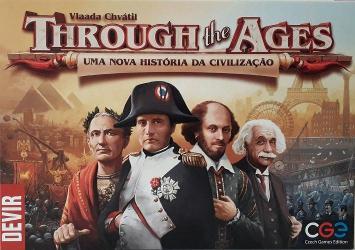
2015 · Civilização
Through the Ages: Uma Nova História da Civilização
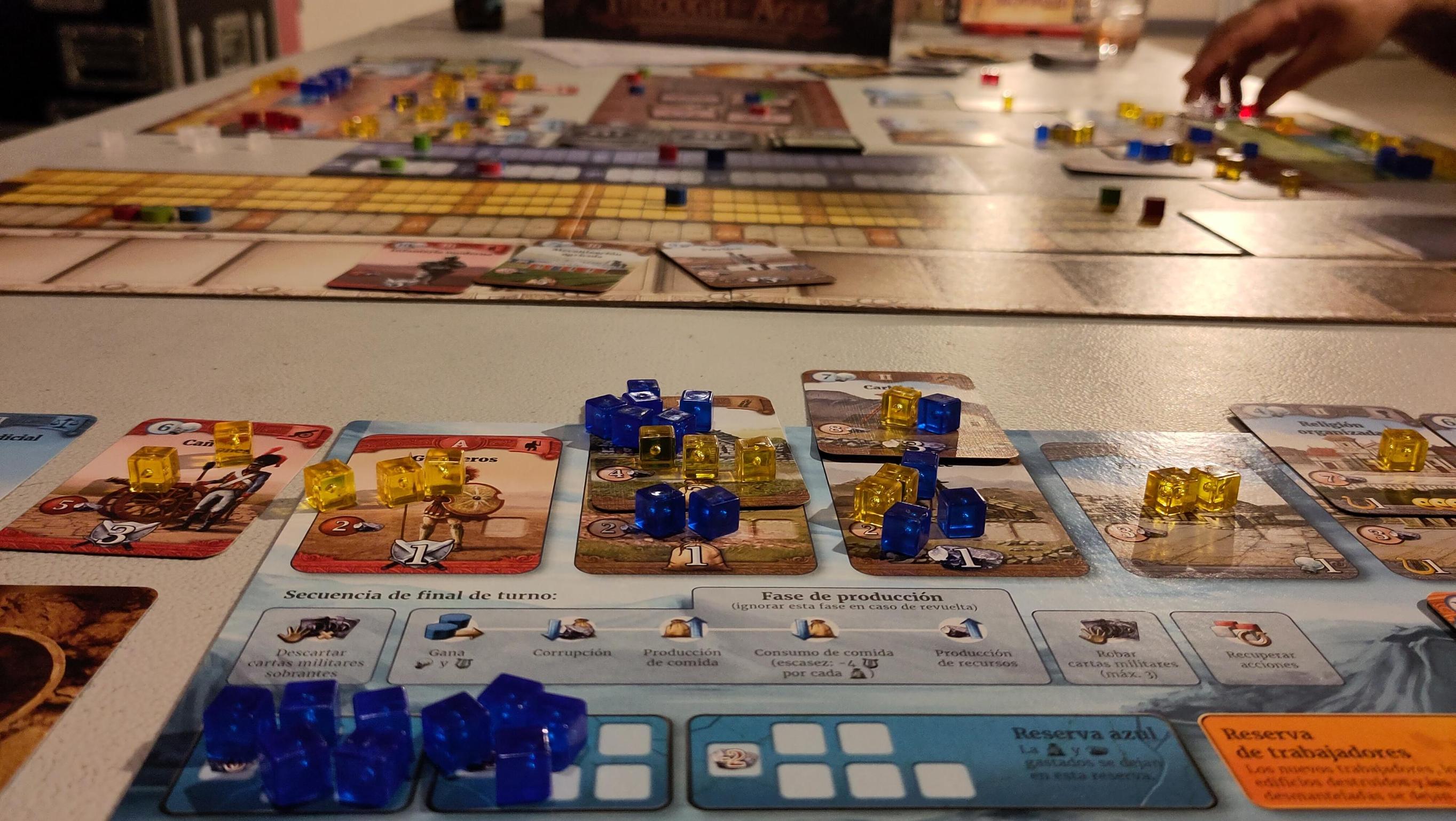
Os jogadores guiam uma civilização desde a Antiguidade até a era moderna, desenvolvendo tecnologias, elegendo líderes, construindo edifícios e maravilhas e administrando alimentos, recursos e população. As cartas de tecnologias, maravilhas e líderes entram em uma fileira de compra compartilhada, onde ficam mais fáceis de adquirir com o tempo; adquirir e ativar cartas exige equilibrar ciência, alimentos e minério. O poder militar é construído por meio de cartas, como as estruturas civis, e afeta os oponentes através de incursões que podem roubar recursos, matar líderes e tomar população ou cultura, embora não exista um mapa territorial. O jogador com mais cultura ao final da era moderna vence.
- Jogadores
- 2–4 melhor com 3
- Tempo de jogo
- 120 min
- Idade
- 14+
- Complexidade
- 4,4 / 5
Sobre o jogo
- Design
- Editora




Expansões
Ver na Ludoya
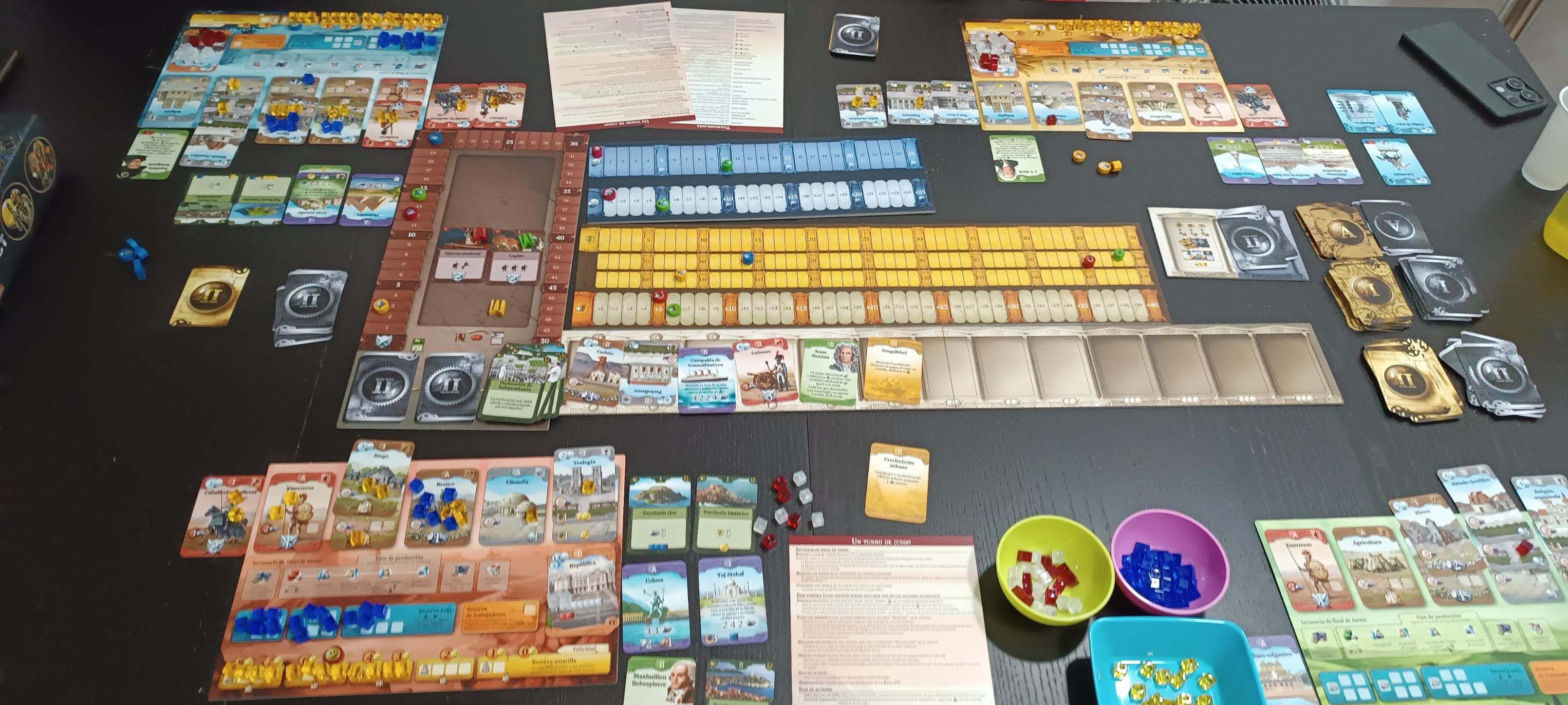
Fotos das mesas da Ludoya
Todas as fotos na Ludoya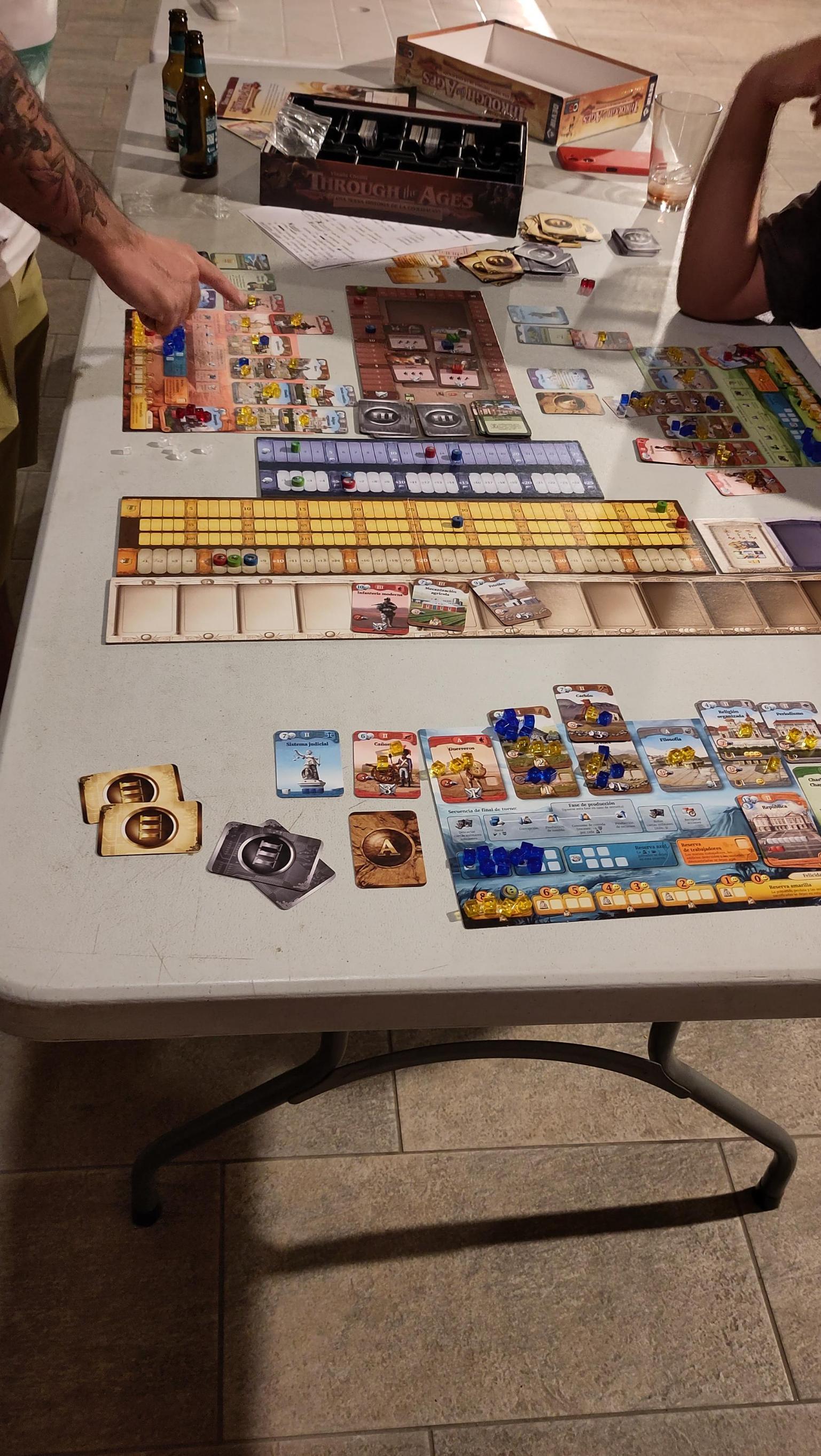
Onde comprar
Preços das lojas e cópias usadas, verificados todos os dias.
Nas mesas da Ludoya
Todas as estatísticas na Ludoya- 1.231
- Partidas registradas
- 457
- Jogadores
- 3h 24m
- Partida média
- 220
- Em ludotecas
- 39
- Em listas de desejos
- 2
- Comprado na pré-venda
7,4/10
de 134 avaliações na Ludoya
Balleflass7,0 Great game, very interestning mechanics, but the biggest gripe/problem is the downtime between players later in the game when people have a ton of cubes and upkeep to do. Stopped playing the physical edition because I prefer Nations as the physical game while playing a ton of TTA on the app.
Evan2,5 This is a card driven civilization game where players use a limited supply of action tokens to take cards and add them to their tableaus or spend them on cards in their tableaus to activate those cards. What you are essentially doing is trying to move your markers up on various tracks in relationship to other players. Then event cards reward you or punish you for your relative position. The most crucial track is the raw points income track. I found cards that give significant improvements on this track to be somewhat rare, and hard to construct when you did get them. Most of these cards require a lot of stone, which is a resource another type of building produces. My second play of this game took about 5.5 hours plus about an hour of rules with 2 players. In that play, I would up missing the 2 stone production building. I wasn’t worried, thinking I would grab the 3 stone building when it finally hit the conveyor belt of cards but due to the random element inherent in a card driven game, the 3 stone card didn’t come out until late into the pile, and despite having a ton of 1 stone production buildings, I fell impossibly behind my opponent in points income. To compensate, I pushed into Military, thinking that If I could hit my opponent with the negative effects of the events it would provide me a catch-up opportunity, but the game has a very odd mechanism for military. You get a separate, much smaller budget of action markers for recruiting military units, and spending to play military event cards. Additionally at the end of your turn, you draw new cards from the event deck equal to the number of unused military actions you have. This meant that I was spending my military actions to build up forces, and my opponent meanwhile was able to fill his hand with either high scoring non-military events he could seed into the events deck, or high value defense cards he could use to counter my aggression and war cards. The result was a lot of failed actions and frustration on my part, as I led on the military track through the entire game, but in 6 hours only got the benefits of hitting my opponent once. My opponent said that by not spending his military actions he also was drawing enough cards that he saw a lot of cards that would have been powerful for me go by and he was able to just discard them. Luck of the draw here also didn’t help me, as I often times would only draw peaceful events and I didn’t much to help my strategy. I enjoyed a lot of the process of this game. I liked the way the cubes moved around the board meaning different things in different places. I liked the card drafting mechanism. I enjoyed the theme. The game also reminded me of a lot of games I’ve really loved in the past, however the downtime between turns is extremely long, and for the overall length of the game I’m not thrilled with the luck driven elements. ★ Art, Iconography and components functional ★ Clever or interesting mechanisms ☆ Reasonably low downtime between turns with mildly AP players ★ Multiple plays stay interesting ☆ Low or mitigatable luck elements ★★☆☆☆ Raw enjoyment
Garfield8,0 #31 Never play it with 4 player! Takes way too long. Beside that it's a very interesting civ game. [c] Theme: ★★★★☆ <!-- size 7]Very good --> Gameplay: ★★★★☆ <!-- size 7]A lot of interesting decisions --> Interaction: ★★★☆☆ <!-- size 7]You can fight a little bit --> Artwork: ★★★☆☆ <!-- size 7]Could be nicer --> Luck: ★★☆☆☆ <!-- size 7]Little, random cards --> Strategy: ★★★★☆ <!-- size 7]Multiple strategies possible --> Components: ★★☆☆☆ <!-- size 7]Could be better --> Play duration: ★☆☆☆☆ <!-- size 7]Unfortunately very long --> Easy to teach: ★★☆☆☆ <!-- size 7]Ok (45min) --> Rules quality: <!-- size 7]not read --> Setup time: ★★★☆☆ <!-- size 7]Ok --> No downtime: ★★★☆☆ <!-- size 7]Ok --> Replay value: ★★★★☆ <!-- size 7]Different strategies possible, a lot of different cards --> [/c]
Próximos eventos com este jogo
Todos os eventosDúvidas de regras
Respondidas a partir do manual pelo assistente de regras da Ludoya.
Como consigo mais trabalhadores/população — tenho que gastar uma ação civil e comida?
Para aumentar a população, você deve gastar uma ação civil e pagar a quantidade necessária de comida; os novos trabalhadores vêm do pool/banco de trabalhadores amarelos. (p9)
Líderes e maravilhas custam uma ação para serem jogados?
Pegar/jogar cartas de líder usa uma ação civil (elas são adquiridas como outras cartas civis), e construir/concluir uma maravilha exige pagar seu custo e seguir as regras de construção. (pp. 10–11)
Quando tenho que descartar cartas militares — descarto no final do meu turno?
Você descarta cartas militares excedentes durante a etapa de descarte do fim do turno sempre que tiver mais cartas militares do que o permitido. (p. 20)
Quando a corrupção reduz minha produção — é imediatamente ou no final do turno?
A corrupção é aplicada durante a etapa de Produção, no final do seu turno, e reduz a sua produção de recursos/pontuação conforme especificado nas regras de produção. (p. 20)
Eu perco meus marcadores amarelos/colonos quando uma Era termina?
No final de uma Era, você perde os marcadores amarelos não utilizados (e remove líderes e maravilhas inacabadas, conforme descrito no procedimento de fim de Era). (p. 21)
Como funcionam as cartas de tática e militares — quando escolho/jogo cada uma e quando as batalhas são resolvidas?
As táticas são escolhidas e as cartas militares são preparadas na fase de política/militar; depois, são reveladas e resolvidas durante a etapa de evento/resolução. Consulte as regras da fase de política e das táticas para saber como escolher, copiar e resolver táticas e exércitos. (p. 16, 18)

Grátis, na web, Android e iOS
Jogue Through the Ages: Uma Nova História da Civilização com a Ludoya
- Tenha na sua ludotecaAcompanhe sua cópia e suas expansões, empreste para os amigos ou coloque na lista de desejos e seja avisado quando o preço cair.Adicionar à sua ludoteca
- Registre cada partidaPontuações, vencedores, cronômetros e fotos, e depois suas estatísticas: taxa de vitórias, número de jogadores favorito, melhor pontuação.Registrar uma partida
- Tire dúvidas de regrasPergunte qualquer coisa sobre as regras e receba uma resposta do manual, com a página para conferir.Perguntar ao assistente de regras
- Encontre gente para jogarClubes, noites de jogos e eventos perto de você que levam este jogo para a mesa.Ver eventos
Dados do jogo (jogadores, tempo de jogo, idade, créditos) do BoardGameGeek.