
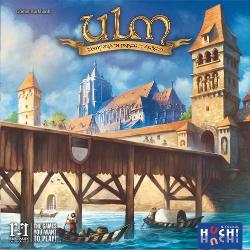
2016 · Mittelalter
Ulm
Die Spieler erweitern ihren Einfluss in einer wohlhabenden freien Reichsstadt des frühen 16. Jahrhunderts, während der Dom im Bau ist. In jedem Zug wird eine einzelne Aktionsplättchen in ein 3x3-Domgitter geschoben, um die drei miteinander verknüpften Aktionen auszuführen, die es auslöst – etwa Waren handeln, Handwerker anwerben, Einfluss bei Zünften und Patriziern gewinnen und den Domturm voranbringen. Das Spiel läuft über eine feste Anzahl an Runden; die Spieler verwalten Ressourcen, Zeit und Arbeiterplatzierung, um in Markt-, Handwerks- und Stadtbereichen Siegpunkte zu sammeln. Der Spieler mit den meisten Punkten, wenn der Dom fertiggestellt ist, gewinnt.
- Spieler
- 2–4 am besten mit 3
- Spielzeit
- 45–75 Min.
- Alter
- 10+
- Komplexität
- 2,7 / 5
Über das Spiel
- Autoren
- Illustration
Fotos von Ludoya-Tischen
Alle Fotos in Ludoya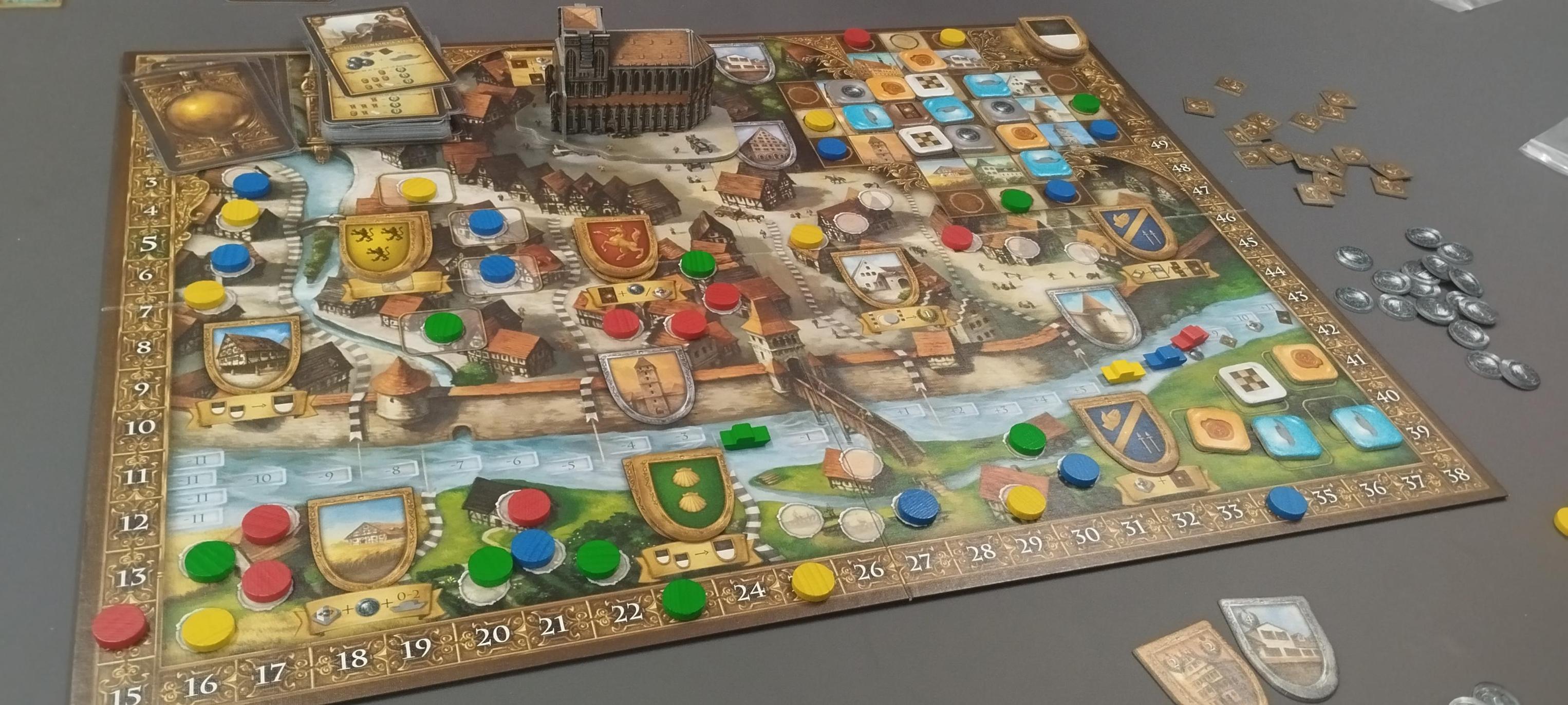
Wo kaufen
Shop-Preise und gebrauchte Exemplare, täglich geprüft.
An Ludoyas Tischen
Alle Statistiken in Ludoya- 101
- Erfasste Partien
- 99
- Spieler
- 1h 22m
- Durchschnittliche Partie
- 19
- In Sammlungen
- 3
- Auf Wunschlisten
4,6/10
aus 19 Ludoya-Rezensionen
Evan2,5 Ulm felt like it could have been a great game. interesting action selection mechanism, players claiming areas so they get a benefit when someone else resolves an action... Unfortunately it fell flat mostly due to randomness. Annoyingly, the rulebook is split across two books for no reason. This makes looking things up a challenge. Then, the basic mechanism of the game is, draw a tile, push it into a row, resolve the 3 central actions in any order of your row including the tile you pushed in. You start the game with 1 tile in your "supply" one might imagine this means you draw a tile, add it to your hand, then choose a tile from your hand and push it in. Unfortunately, the rules state you must push in the tile you drew that turn, so you get to know what 2 of your 3 actions are and the third is totally random. The tiles in your supply are used only for discarding to pay for the effect of, or to acquire cards. The cards when played have a choice of giving you an immediate effect or adding them to end of game scoring sets. Of course, getting and playing these cards requires some luck in terms of what tile effect you are able to activate. One of the actions is a seal, which lets you place a marker either above or below your boat along the river. This is an interesting limitation on your actions, because you want to move the boat along the river, because that's where points are, but the further you go the more actions are no longer available to you. Here's the problem. The actions above and below the river are what get claimed by players. One of the river abilities is to randomly draw 2 location tiles keep one. About half of them are one and done score points, the other half let you claim locations. So maybe you draw the location that's at the start of the river late in the game when nobody can resolve that action anymore. The game does have some luck mitigation. Most things are draw 2 keep 1 and there are ability tiles that can mitigate some of the luck. There are also sparrow tokens worth 1vp each if unspent, that can be spent to let you swap your draw with one from a faceup market display. The question is, how many times do you spend 1vp to swap your useless draw for an ok tile before the market is full of garbage and you are out of 1vp tiles? :nostar: Art, Iconography and components functional :star: Clever or interesting mechanisms :star: Reasonably low downtime between turns with mildly AP players :star: Multiple plays stay interesting :nostar: Low or mitigatable luck elements :star::nostar::nostar::nostar::nostar: Raw enjoyment
Garfield5,0 #AreaControl #SetCollecting Themeless and pretty much luckbased. [c] Theme: :star::nostar::nostar::nostar::nostar: <!-- size 7]Not really --> Gameplay: :star::star::nostar::nostar::nostar: <!-- size 7]Slightly boring --> Interaction: :star::nostar::nostar::nostar::nostar: <!-- size 7]Nope --> Artwork: :star::star::nostar::nostar::nostar: <!-- size 7]Nothing special --> Luck: :star::star::star::star::nostar: <!-- size 7]Card drawing luck, tile drawing luck --> Strategy: :star::star::nostar::nostar::nostar: <!-- size 7]Little --> Components: :star::star::star::nostar::nostar: <!-- size 7]Good --> Play duration: :star::star::star::nostar::nostar: <!-- size 7]Ok, but could be shorter --> Easy to teach: :star::star::nostar::nostar::nostar: <!-- size 7]A lot of actions to explain --> Setup time: :star::star::star::star::nostar: <!-- size 7]Quick --> No downtime: :star::star::star::nostar::nostar: <!-- size 7]Little to huge --> [/c]
Regelfragen



Kostenlos, im Web, für Android und iOS
Spiel Ulm mit Ludoya
- Hab es in deiner SammlungVerwalte dein Exemplar und seine Erweiterungen, leih es Freunden oder setz es auf deine Wunschliste und erfahre, wenn der Preis fällt.Zur Sammlung hinzufügen
- Erfasse jede PartiePunkte, Sieger, Timer und Fotos, dann deine Statistiken: Siegquote, liebste Spielerzahl, beste Punktzahl.Partie erfassen
- Werte ohne PapierNutze die Wertungsbögen und Spielhelfer der Community und lass Ludoya die Punkte zusammenzählen.Wertungsbögen finden
- Finde Leute, mit denen du es spielstClubs, Spieleabende und Veranstaltungen in deiner Nähe, bei denen dieses Spiel auf den Tisch kommt.Veranstaltungen ansehen
Spieldaten (Spieler, Spielzeit, Alter, Mitwirkende) von BoardGameGeek.