
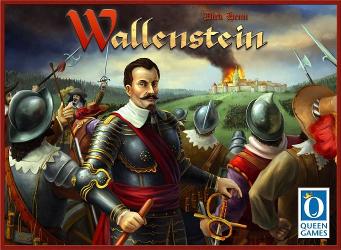
2012 · Wirtschaft
Wallenstein (Second Edition)
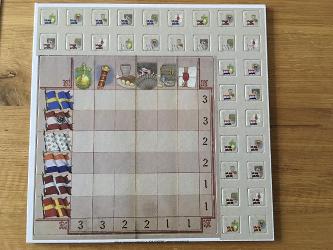
Die Spieler übernehmen die Rollen von Militärführern während des Dreißigjährigen Krieges und manövrieren Armeen, ziehen Steuern und Getreide ein und bauen Paläste und Kirchen, um die Kontrolle über Land über zwei simulierte „Jahre“ zu sichern. In jeder Aktionssaison (Frühling, Sommer, Herbst) wird eine Mischung aus offenen und verdeckten Aktionskarten verwendet; die Spieler weisen ihren persönlichen County-Karten heimlich die zehn Aktionsfelder auf ihrem Spielertableau zu und bieten um die Zugreihenfolge sowie Bonusplättchen, bevor die Aktionen abgewickelt werden. Konflikte und Aufstände werden mit einem Würfelturm gelöst: Holzklötze für Armeen und Bauern werden hineingeworfen, und die, die herauskommen, bestimmen die Kampfstärke, während andere für später stecken bleiben können. Ressourcenmanagement (Geld und Getreide) beeinflusst Rekrutierung, Bau und das Risiko von Aufständen. Zwei optionale Module fügen einen kaiserlichen Hof mit Höflingen hinzu, die um Gunst konkurrieren, sowie eine gestapelte Bonuskarten-Mechanik, die regionale Kontrolle belohnt; gedacht ist das Spiel für drei bis fünf Spieler.
- Spieler
- 3–5 am besten mit 5
- Spielzeit
- 90–120 Min.
- Alter
- 12+
- Komplexität
- 3,2 / 5
Über das Spiel
- Autoren
- Illustration
- Publisher



Erweiterungen
In Ludoya ansehen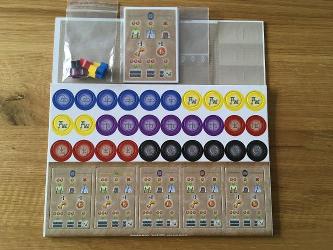
An Ludoyas Tischen
Alle Statistiken in Ludoya- 16
- Erfasste Partien
- 26
- Spieler
- 2h 44m
- Durchschnittliche Partie
- 11
- In Sammlungen
- 3
- Auf Wunschlisten
6,5/10
aus 10 Ludoya-Rezensionen
Evan5,9 In this game you get a hand of cards that match the areas you control. On your player board you have card slots that match the different actions that happen each round. During the preparation phase, you program those actions by placing the region cards on them, meaning the action will happen in the region you assign to the slot. The order of actions is randomized, and half of them are public knowlage at the start of the round. The rest get revealed as they happen. The game can feel complicated, but it flows smoothly as most of the actions can be resolved simultaneously. Combat is quick and interesting, as it involves dumping everyone's cubes into a tower and whomever has more spill out is the winner. The cost is that for every one of the defender's cubes that came out, the winner will also lose that many cubes. Cubes that retain in the tower will help you in your future battles. In this way you achieve a semi-random combat system, but the victum of this round's randomness has an advantage in future battles. The one complaint about this game is the thing that makes it the most interesting. It feels like a dudes on the map game, on shuffle mode. You know where you want your actions to happen, but maybe someone takes that spot out from under you before it resolves. Maybe the order in which the actions happen makes it so that you can't afford the action you selected. Maybe the amount of grain needed to feed your spots at the end of the round is more than you planned for, and the peasants revolt causing you to lose spots. Maybe every combat you get into, both players tie and the spot gets wiped including the high value buildings you spent time making. I go back and forth being thrilled and frustrated. :star: Art, Iconography and components functional :star: Clever or interesting mechanisms :star: Reasonably low downtime between turns with mildly AP players :star: Multiple plays stay interesting :star: Low or mitigatable luck elements :star::star::nostar::nostar::nostar: Raw enjoyment
Mestremuten7,0 Rating: 4/5 Production value: 3/4 Is the game in my collection/Love to have?: 0/1
Dragonshiq8,0 inclus in "Wallenstein Big Box"




Kostenlos, im Web, für Android und iOS
Spiel Wallenstein (Second Edition) mit Ludoya
- Hab es in deiner SammlungVerwalte dein Exemplar und seine Erweiterungen, leih es Freunden oder setz es auf deine Wunschliste und erfahre, wenn der Preis fällt.Zur Sammlung hinzufügen
- Erfasse jede PartiePunkte, Sieger, Timer und Fotos, dann deine Statistiken: Siegquote, liebste Spielerzahl, beste Punktzahl.Partie erfassen
- Werte ohne PapierNutze die Wertungsbögen und Spielhelfer der Community und lass Ludoya die Punkte zusammenzählen.Wertungsbögen finden
- Finde Leute, mit denen du es spielstClubs, Spieleabende und Veranstaltungen in deiner Nähe, bei denen dieses Spiel auf den Tisch kommt.Veranstaltungen ansehen
Spieldaten (Spieler, Spielzeit, Alter, Mitwirkende) von BoardGameGeek.