
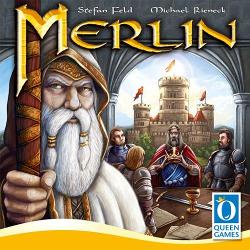
2017 · Médiéval
Merlin
Les joueurs incarnent des chevaliers et Merlin, qui se déplacent sur un anneau d’actions à l’aide de dés pour déclencher les actions souhaitées. Les chevaliers ne peuvent être déplacés que par leur propriétaire, tandis que Merlin peut être déplacé par n’importe quel joueur, ce qui demande un timing et une coordination minutieux. Les points sont gagnés de plusieurs façons : vaincre des barbares, construire des manoirs dans les régions environnantes, accroître son influence dans six comtés et accomplir des cartes Mission pendant les tours. Le jeu récompense la planification et l’enchaînement efficaces des actions afin d’accumuler le plus de points de victoire et d’être choisi comme successeur du roi Arthur.
- Joueurs
- 2–4 idéal à 3
- Temps de jeu
- 75 min
- Âge
- 14+
- Complexité
- 3,1 / 5
À propos du jeu
- Auteurs
- Illustration
- Publisher




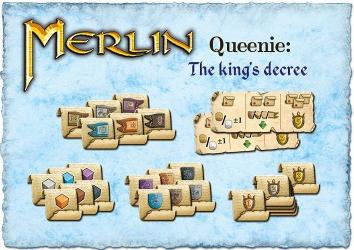
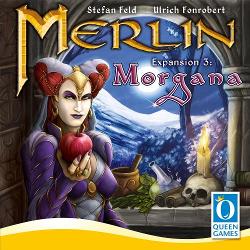
Extensions
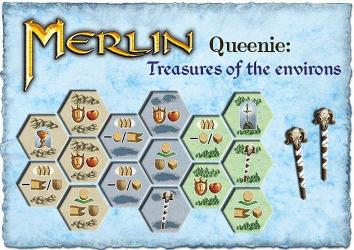
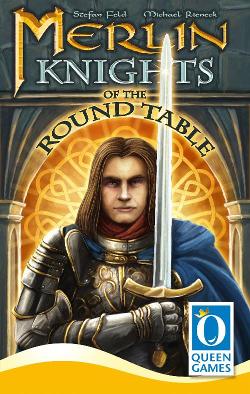
Les voir dans Ludoya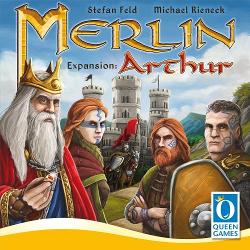
Où l'acheter
Prix des boutiques et exemplaires d'occasion, vérifiés chaque jour.
Sur les tables de Ludoya
Toutes les statistiques dans Ludoya- 91
- Parties enregistrées
- 110
- Joueurs
- 1h 38m
- Partie moyenne
- 32
- Dans des collections
- 5
- Dans des listes de souhaits
5,0/10
sur 27 avis Ludoya
Evan4,6 In this game, each player rolls their dice and on their turn chooses one, moves a pawn of the matching color on the action selection wheel a number of spaces equal to the pips on that die and resolves the effect of the space. Since you everyone rolls their dice at the start of each round, the interesting puzzle of the game if figuring out the order you want to use your dice. This gets more interesting when you consider one pawn is shared among all players, so predicting where you think your opponents will move it is crucial to your success. Essentially what you do in the game is collect different types of tokens, or place a piece to compete for one of many different majority scorings. The core spaces do do this are the six colored castles that live four spaces away from each other on the action selection wheel. When you go to a castle, you can place one of your circle pawns there and then get a thing pictures on the pawn. This could be a cube which you need to build houses on the hex map, a flag which you could discard later to use it's powerful ability, a shield token you might need to fend off randomly assigned -3VP invader tokens of the matching color, or you could place an influence marker in the region to attempt to compete for that castle's majority scoring. Other action spaces involve actually building a house on the hex map, or scoring points for each of a specific type of token you've collected, or getting a benefit from a castle you have an influence marker in. The core of everything that's happening is very solid. The game just feels a bit unedited and unfocused. The external hex map as a mechanism feels disjointed from the rest of what's happening in the game. There are a few action spaces that aren't very compelling, but because of your dice you might get stuck with. Some of the flag abilities are better than others as well. A lot of this is addressed with the Arthur expansion. This expansion replaces two of the flags, adds an extra shared pawn to the game and removes a lot of the less desirable action spaces. Unfortunately, it comes with it's own problems. It adds extra spaces that allow for the movement of the shared pawns, which eliminates much of your ability to plan out your turn which is really the core appeal of the game. It also adds a mechanism where you need to collect a new type of tile only available from the new shared pawn's inner action wheel. Having the lowest sum of those tiles at the end of the round means a -3VP penalty and the player with the highest gets +3VP. The numbers and rewards on these tiles is highly subject to the flip luck of what's available, and of course having the shared pawn in a position such that you are capable of taking a tile. The expansion does add significantly more luck mitigation for your dice, which was something present in the base game, but not quite to the same extent. Of course, the issue with giving players more flexibility is you again lose some more of your ability to plan your turns properly. All in all, the game stands very close to being great, but it gets in it's own way a little too much. The same game with a few details refined and a few superfluous mechanisms shaved off would be an incredible experience. :star: Art, Iconography and components functional :star: Clever or interesting mechanisms :nostar: Reasonably low downtime between turns with mildly AP players :nostar: Multiple plays stay interesting :star: Low or mitigatable luck elements :star::star::star::nostar::nostar: Raw enjoyment
Garfield2,0 I wanted to like it, but I can't. Why? Because a lot depends on your dice rolls. You can mitigate it with your flags, but of course you have to collect them which is also like wasting an action. I just won because in the last round I was very lucky with my dice roll and I overtook all others. One pip less on a die can mean you can't score 7 points, instead you score 0 points. [c] Theme: :star::star::nostar::nostar::nostar: <!-- size 7]I don't feel it --> Gameplay: :star::star::star::star::nostar: <!-- size 7]Good amount of choices --> Interaction: :star::star::nostar::nostar::nostar: <!-- size 7]A little bit area control --> Artwork: :star::star::star::nostar::nostar: <!-- size 7]Ok --> Luck: :star::star::star::star::nostar: <!-- size 7]Dice rolling --> Strategy: :star::star::nostar::nostar::nostar: <!-- size 7]Mostly driven by your dice rolls --> Components: :star::star::star::nostar::nostar: <!-- size 7]Ok, nothing special --> Play duration: :star::star::star::star::nostar: <!-- size 7]Good for such a game --> Easy to teach: :star::star::nostar::nostar::nostar: <!-- size 7]A lot to teach (45min) --> Rules quality: <!-- size 7]not read --> Setup time: :star::star::nostar::nostar::nostar: <!-- size 7]It takes a little bit --> No downtime: :star::star::star::nostar::nostar: <!-- size 7]Ok --> Replay value: :star::star::nostar::nostar::nostar: <!-- size 7]Nothing changes that much --> [/c]
Mestremuten6,0 Rating: 3/5 Production value: 3/4 Is the game in my collection/Love to have?: 0/1





Gratuit, sur le web, Android et iOS
Jouez à Merlin avec Ludoya
- Gardez-le dans votre collectionSuivez votre exemplaire et ses extensions, prêtez-le à vos amis ou ajoutez-le à votre liste de souhaits et soyez prévenu quand le prix baisse.Ajouter à votre collection
- Enregistrez chaque partieScores, gagnants, minuteurs et photos, puis vos statistiques : taux de victoire, nombre de joueurs préféré, meilleur score.Enregistrer une partie
- Comptez les points sans papierUtilisez les feuilles de score et les aides de jeu de la communauté, et laissez Ludoya additionner les points.Trouver des feuilles de score
- Trouvez des gens avec qui y jouerClubs, soirées jeux et événements près de chez vous qui mettent ce jeu sur la table.Voir les événements
Données du jeu (joueurs, durée, âge, crédits) issues de BoardGameGeek.