
2015 · Económico
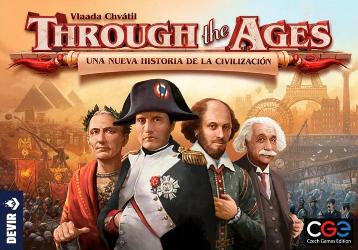
Through the Ages: Una Nueva Historia de la Civilización
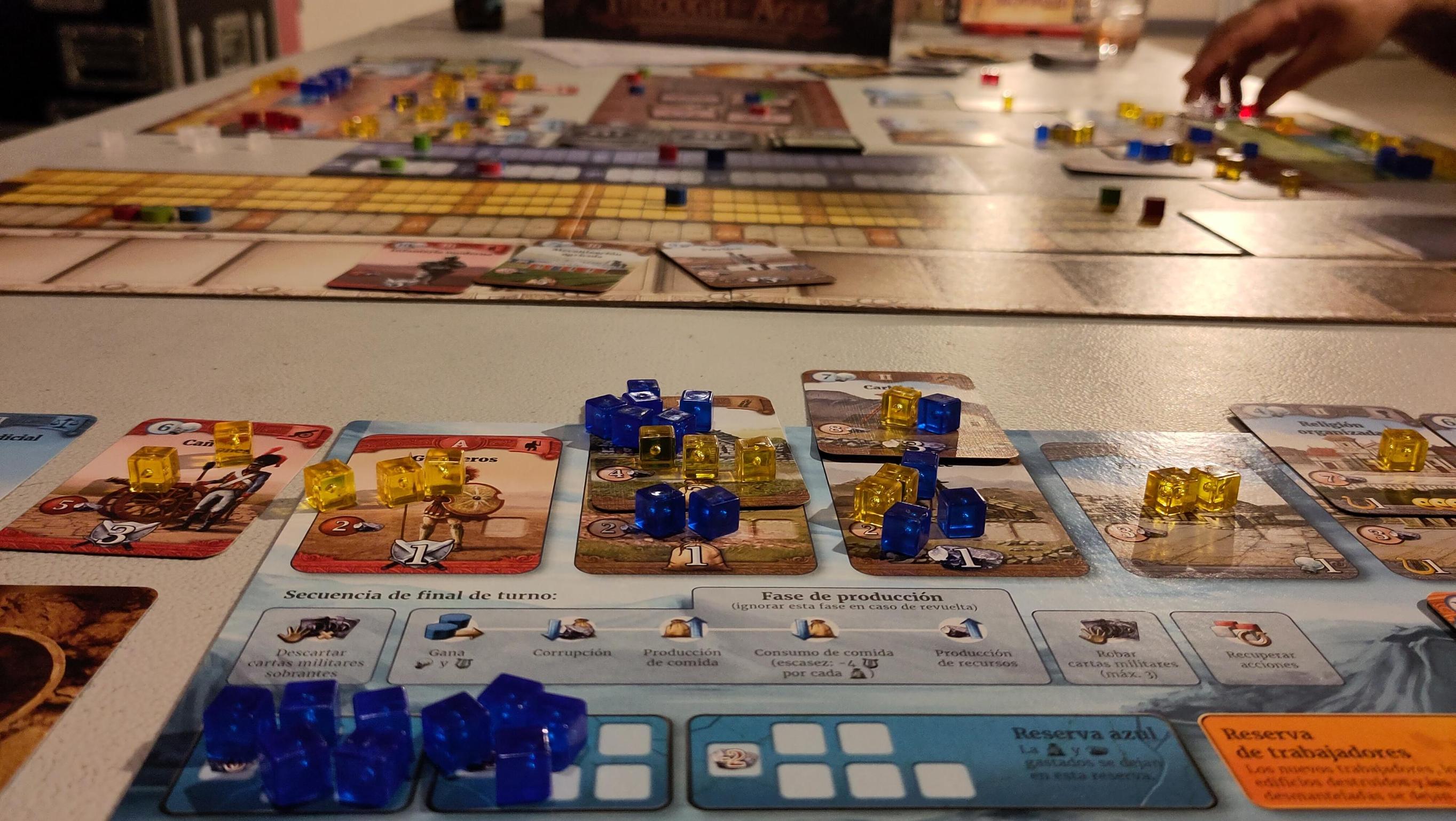
Los jugadores guían una civilización desde la antigüedad hasta la era moderna, desarrollando tecnologías, eligiendo líderes, construyendo edificios y maravillas, y gestionando comida, recursos y población. Las cartas de tecnologías, maravillas y líderes entran en una fila común de draft donde con el tiempo se vuelven más fáciles de conseguir; adquirir y activar cartas requiere equilibrar ciencia, comida y mineral. La fuerza militar se construye mediante cartas como estructuras civiles y afecta a los oponentes a través de incursiones que pueden robar recursos, matar líderes, quitar población o cultura, aunque no hay un mapa territorial. El jugador con más cultura al final de la era moderna gana.
- Jugadores
- 2–4 mejor con 3
- Duración
- 120 min
- Edad
- 14+
- Complejidad
- 4,4 / 5
Sobre el juego
- Diseño
- Publisher




Expansiones
Verlas en Ludoya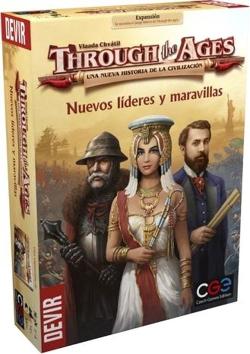
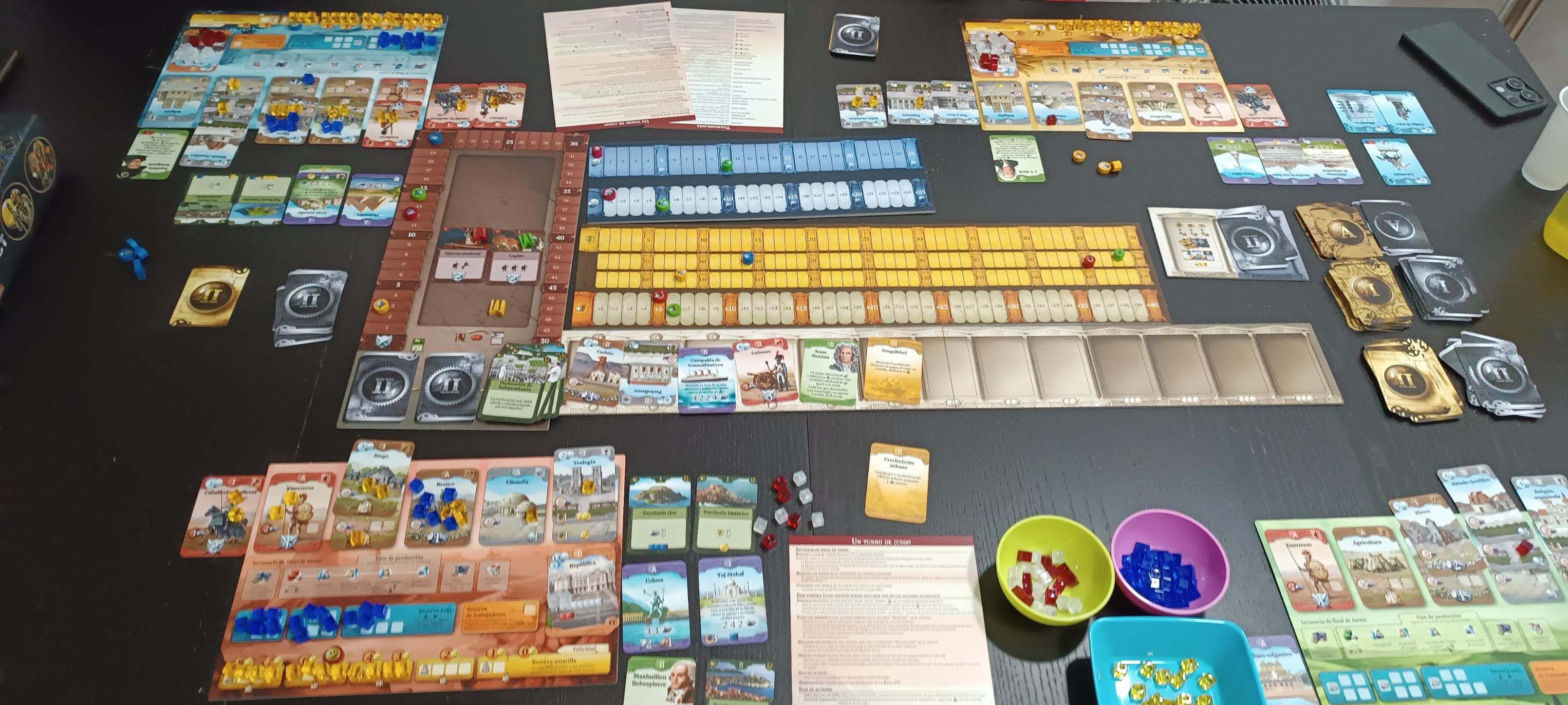
Fotos de mesas de Ludoya
Todas las fotos en Ludoya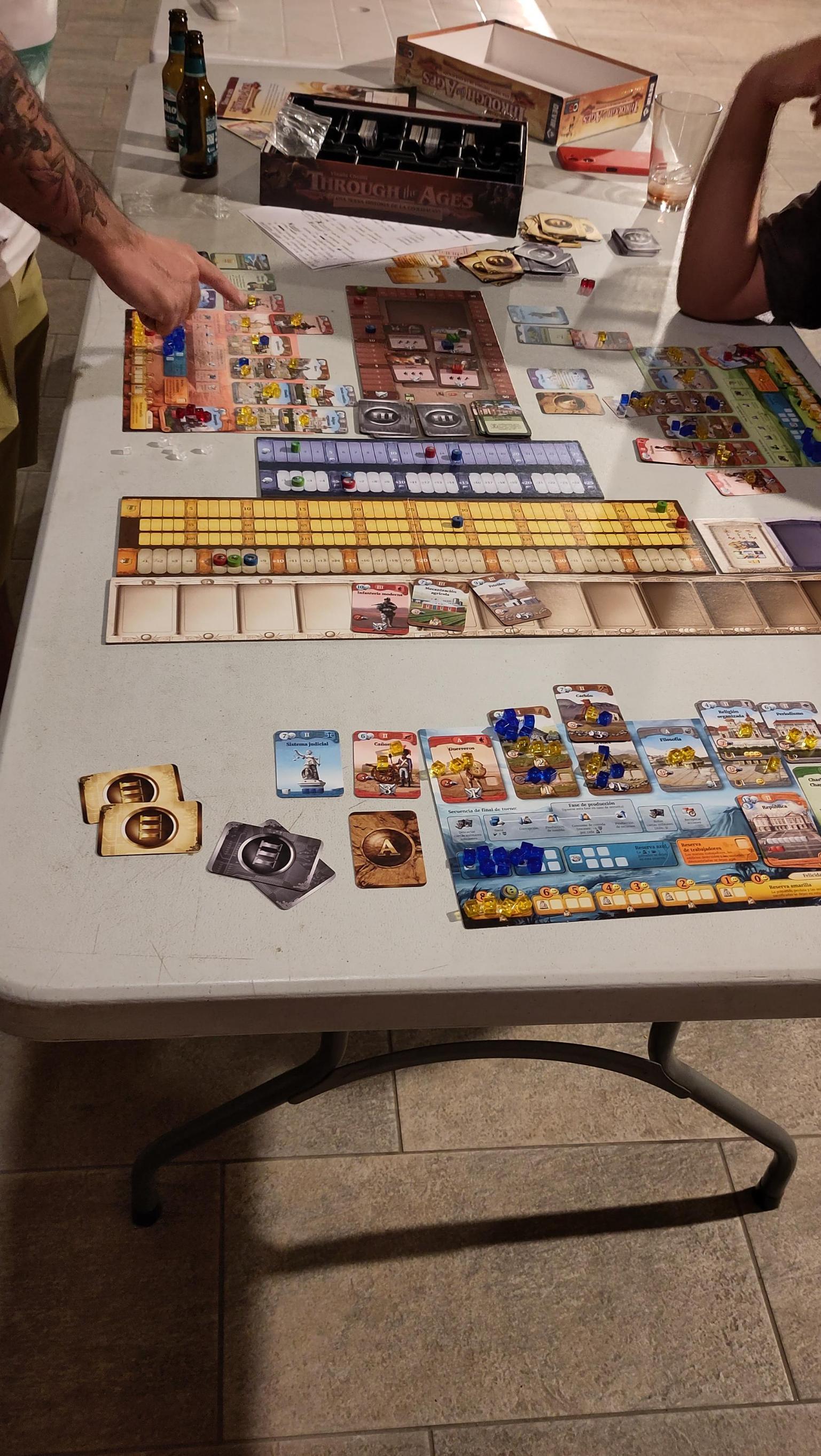
Dónde comprarlo
Precios de tiendas y copias de segunda mano, revisados cada día.
En las mesas de Ludoya
Todas las estadísticas en Ludoya- 1230
- Partidas registradas
- 455
- Jugadores
- 3h 23m
- Partida media
- 216
- En colecciones
- 37
- En listas de deseos
- 2
- En preventa
7,4/10
de 134 reseñas en Ludoya
Moi8,3 Sabe transmitir perfectamente la esencia de un juego de civilizaciones sintetizando mucho los conceptos, pecando a veces de ser demasiado abstracto para algunos.
Balleflass7,0 Great game, very interestning mechanics, but the biggest gripe/problem is the downtime between players later in the game when people have a ton of cubes and upkeep to do. Stopped playing the physical edition because I prefer Nations as the physical game while playing a ton of TTA on the app.
Evan2,5 This is a card driven civilization game where players use a limited supply of action tokens to take cards and add them to their tableaus or spend them on cards in their tableaus to activate those cards. What you are essentially doing is trying to move your markers up on various tracks in relationship to other players. Then event cards reward you or punish you for your relative position. The most crucial track is the raw points income track. I found cards that give significant improvements on this track to be somewhat rare, and hard to construct when you did get them. Most of these cards require a lot of stone, which is a resource another type of building produces. My second play of this game took about 5.5 hours plus about an hour of rules with 2 players. In that play, I would up missing the 2 stone production building. I wasn’t worried, thinking I would grab the 3 stone building when it finally hit the conveyor belt of cards but due to the random element inherent in a card driven game, the 3 stone card didn’t come out until late into the pile, and despite having a ton of 1 stone production buildings, I fell impossibly behind my opponent in points income. To compensate, I pushed into Military, thinking that If I could hit my opponent with the negative effects of the events it would provide me a catch-up opportunity, but the game has a very odd mechanism for military. You get a separate, much smaller budget of action markers for recruiting military units, and spending to play military event cards. Additionally at the end of your turn, you draw new cards from the event deck equal to the number of unused military actions you have. This meant that I was spending my military actions to build up forces, and my opponent meanwhile was able to fill his hand with either high scoring non-military events he could seed into the events deck, or high value defense cards he could use to counter my aggression and war cards. The result was a lot of failed actions and frustration on my part, as I led on the military track through the entire game, but in 6 hours only got the benefits of hitting my opponent once. My opponent said that by not spending his military actions he also was drawing enough cards that he saw a lot of cards that would have been powerful for me go by and he was able to just discard them. Luck of the draw here also didn’t help me, as I often times would only draw peaceful events and I didn’t much to help my strategy. I enjoyed a lot of the process of this game. I liked the way the cubes moved around the board meaning different things in different places. I liked the card drafting mechanism. I enjoyed the theme. The game also reminded me of a lot of games I’ve really loved in the past, however the downtime between turns is extremely long, and for the overall length of the game I’m not thrilled with the luck driven elements. :star: Art, Iconography and components functional :star: Clever or interesting mechanisms :nostar: Reasonably low downtime between turns with mildly AP players :star: Multiple plays stay interesting :nostar: Low or mitigatable luck elements :star::star::nostar::nostar::nostar: Raw enjoyment

Próximos eventos con este juego
Todos los eventosDudas de reglas
Respondidas a partir del reglamento por el asistente de reglas de Ludoya.
How do I get more workers/population — do I have to spend a civil action and food?
To increase population you must spend one civil action and pay the required food; new workers come from the yellow worker pool/bank. (p9)
Do leaders and wonders cost an action to play?
Taking/playing leader cards uses a civil action (they are acquired like other civil cards), and placing/completing a wonder requires paying its cost and following the build rules. (pp10–11)
When do I have to discard military cards — do I discard at the end of my turn?
You discard excess military cards during the end-of-turn discard step whenever you have more than the allowed military cards. (p20)
When does corruption reduce my production — is it immediate or at the end of the turn?
Corruption is applied during the Production step at the end of your turn and reduces your resource production/score as specified in the production rules. (p20)
Do I lose my yellow tokens/colonists when an Age ends?
At the end of an Age you lose unused yellow tokens (and remove leaders and unfinished wonders as described in the end-of-Age procedure). (p21)
How do tactics and military cards work — when do I choose/play them and when are battles resolved?
Tactics are chosen and military cards are prepared in the politics/military phase, then revealed and resolved during the event/resolution step; see the politics phase and tactics rules for choosing, copying and resolving tactics and armies. (pp16, 18)
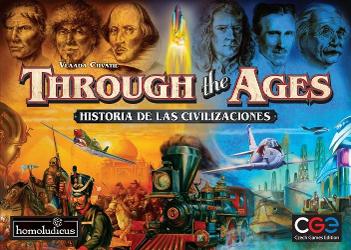
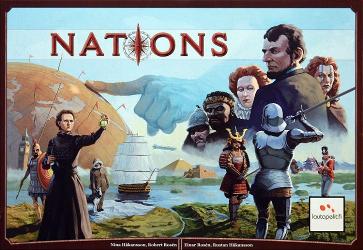
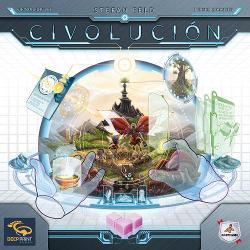
Juegos similares

Gratis, en web, Android e iOS
Juega a Through the Ages: Una Nueva Historia de la Civilización con Ludoya
- Tenlo en tu colecciónControla tu copia y sus expansiones, préstala a tus amigos o ponla en tu lista de deseos y te avisamos cuando baje de precio.Añadirlo a tu colección
- Registra cada partidaPuntuaciones, ganadores, temporizadores y fotos, y luego tus estadísticas: porcentaje de victorias, número de jugadores favorito, mejor puntuación.Registrar una partida
- Resuelve dudas de reglasPregunta lo que quieras sobre las reglas y obtén una respuesta sacada del reglamento, con la página donde comprobarla.Preguntar al asistente de reglas
- Encuentra gente con quien jugarloClubes, noches de juegos y eventos cerca de ti que sacan este juego a la mesa.Ver eventos
Datos del juego (jugadores, duración, edad, créditos) de BoardGameGeek.