
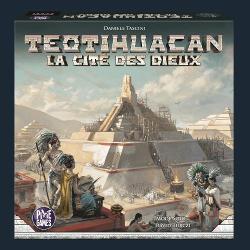
2018 · Construction de villes
Teotihuacan: La Cité Des Dieux
Les joueurs contrôlent des dés ouvriers qui gagnent en puissance au fur et à mesure de leurs actions, en déplaçant un seul dé sur un plateau modulaire représentant la ville et en effectuant l’action d’une des deux cases de chaque tuile. À leur tour, les joueurs choisissent entre faire une action et améliorer cet ouvrier, ou prendre un bonus immédiat sans amélioration, tout en gérant les ressources et la nécessité de nourrir leur main-d’œuvre. Les actions permettent de développer des technologies, construire des habitations, progresser sur trois grands temples et contribuer à la pyramide à degrés centrale sur trois ères successives. La victoire se joue à la renommée accumulée après des décomptes périodiques.
- Joueurs
- 1–4 idéal à 4
- Temps de jeu
- 90–120 min
- Âge
- 14+
- Complexité
- 3,8 / 5
À propos du jeu
- Auteurs
- Illustration
- Éditeur



Extensions
Les voir dans Ludoya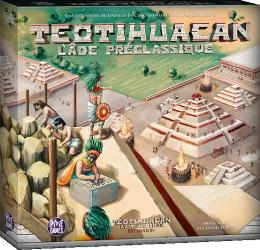 Teotihuacan: L'Age Préclassique2019
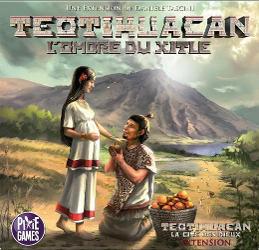 Teotihuacan: L'Ombre du Xitle2021
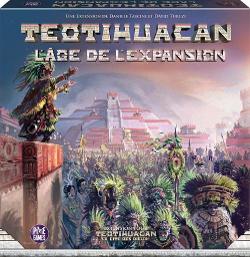 Teotihuacan: L'âge de l'expansion2021
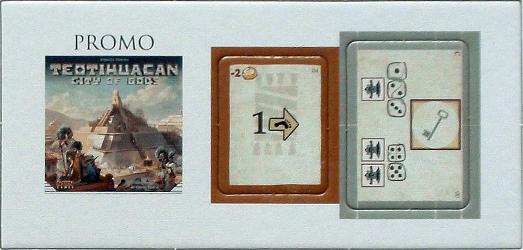 Teotihuacan: Dice Settlers Promo2018
 Teotihuacan: City of Gods – Pyramid Tile Promo, Red Temple2019
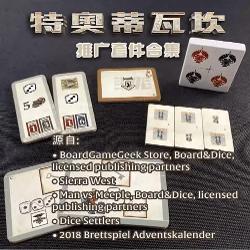 Teotihuacan: City of Gods – Promo Bundle2020
 Teotihuacan: City of Gods – 5th Player Expansion2020
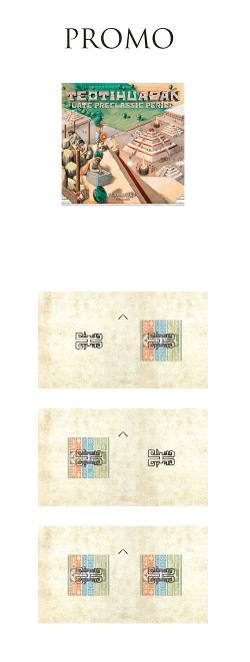 Teotihuacan: City of Gods – Decoration Tiles2019
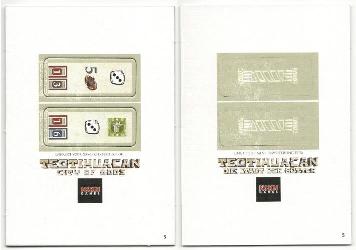 Teotihuacan: Brettspiel Adventskalender 2018 Promo2018
 Loot Box #12022
 Teotihuacan: City of Gods – Man vs Meeple Promo2019
 Brettspiel Adventskalender 20182018
 Teotihuacan: Expert Challenges – Book 12021
 Teotihuacan: Expert Challenges – Book 22021
 Teotihuacan: Expert Challenges – Book 32022
 Teotihuacan: New Priests2024
 Teotihuacan: City of Gods – 5th Player Expansion2024
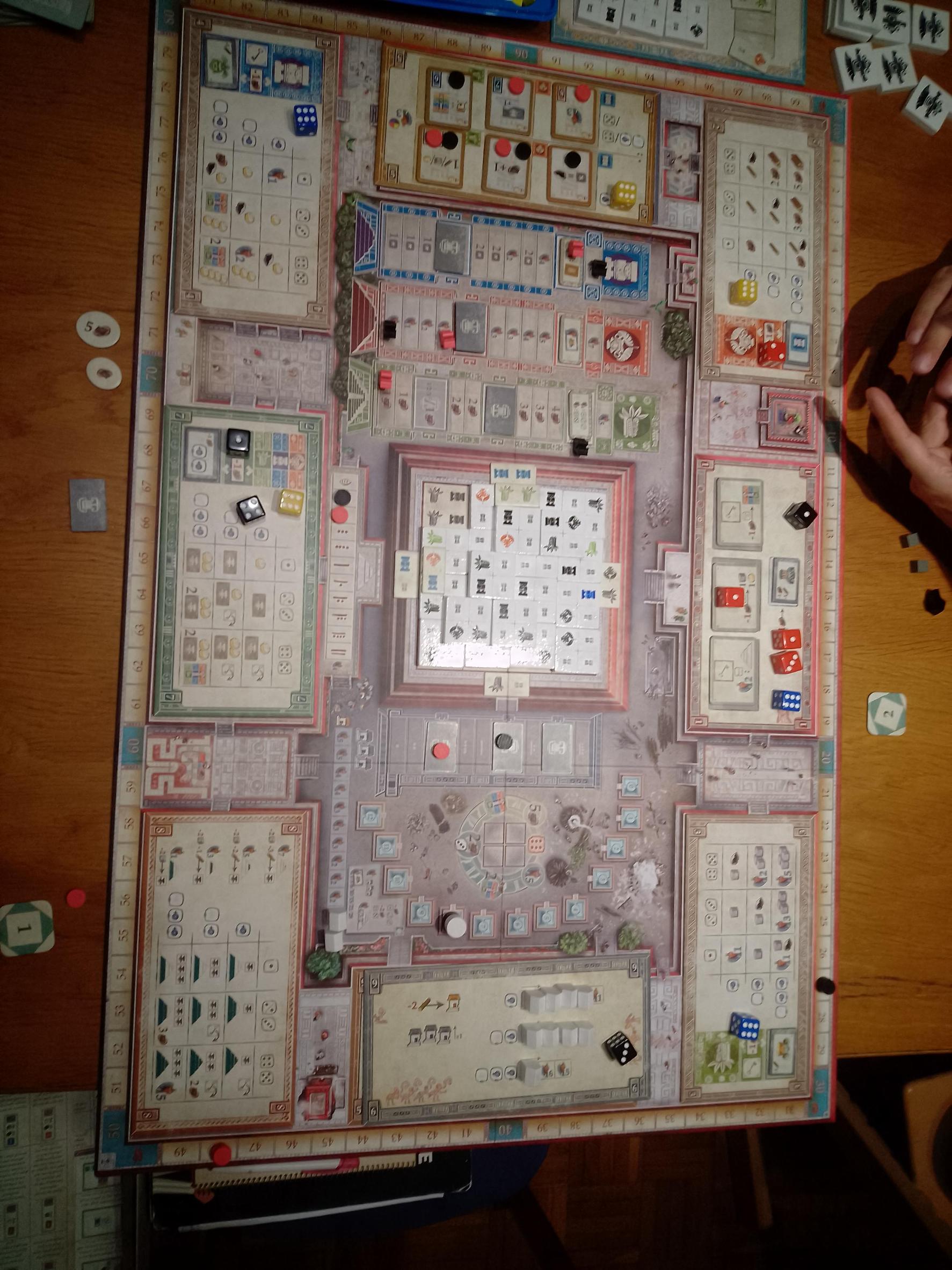
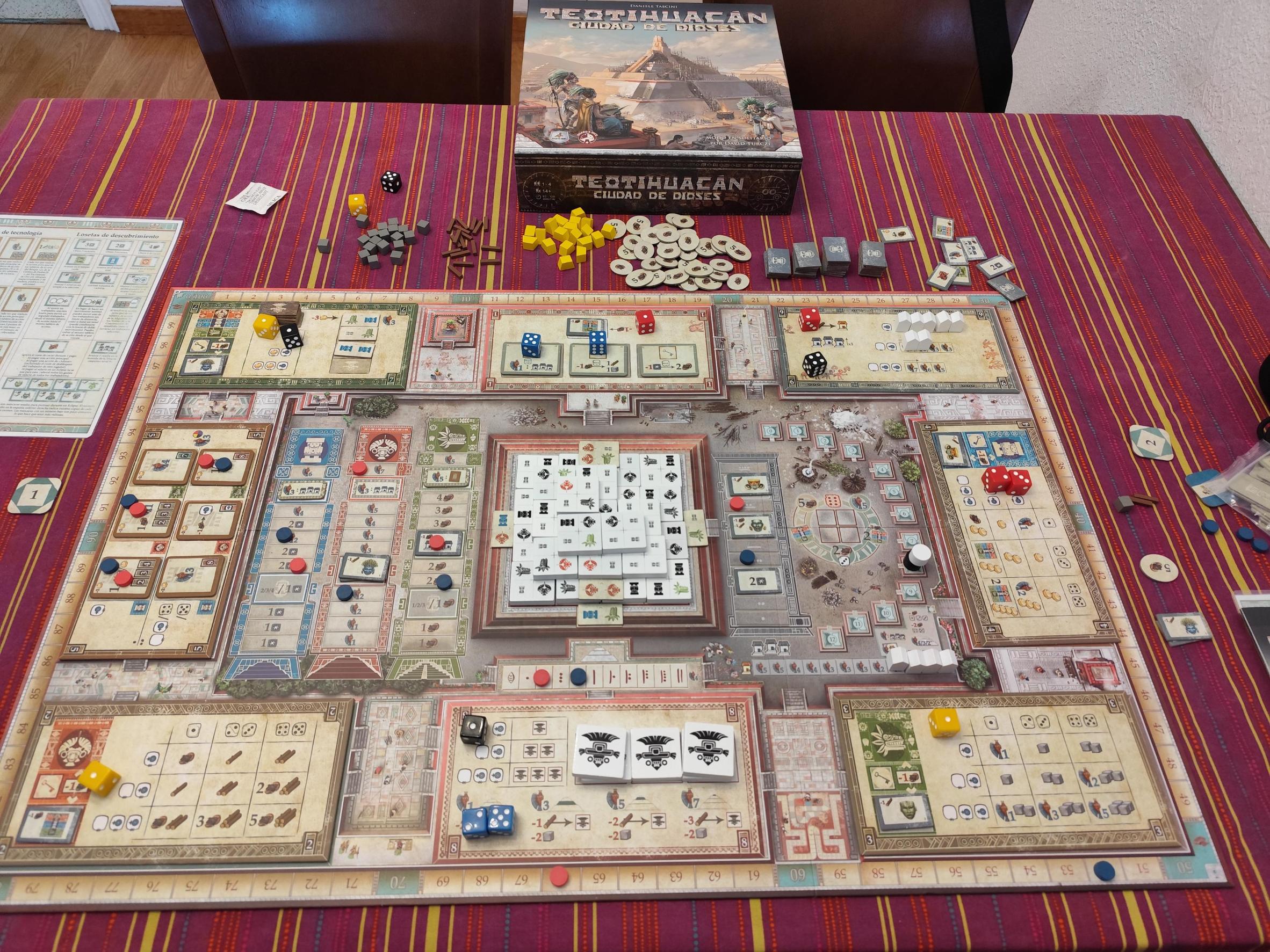
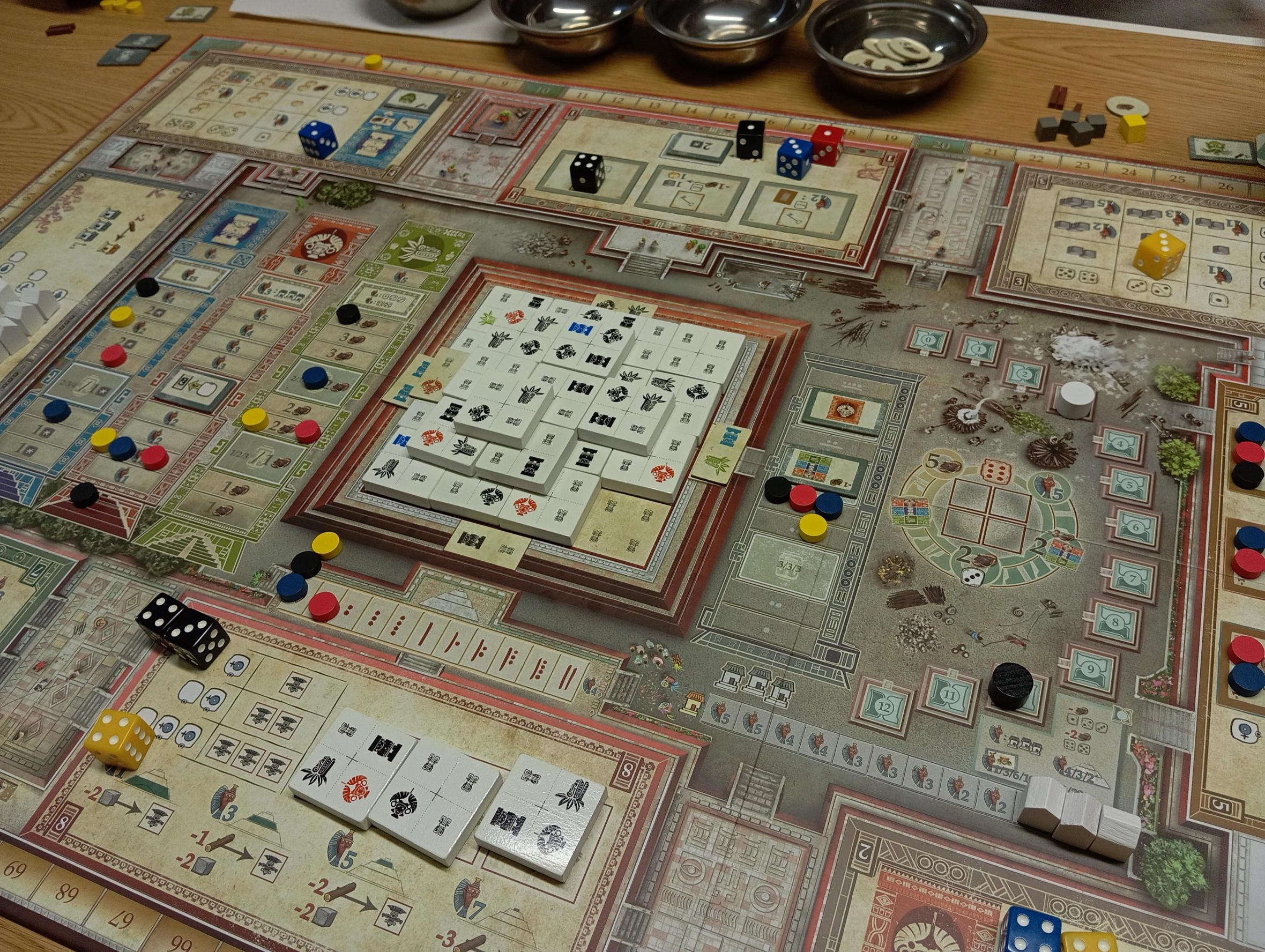
Photos des tables de Ludoya
Toutes les photos dans Ludoya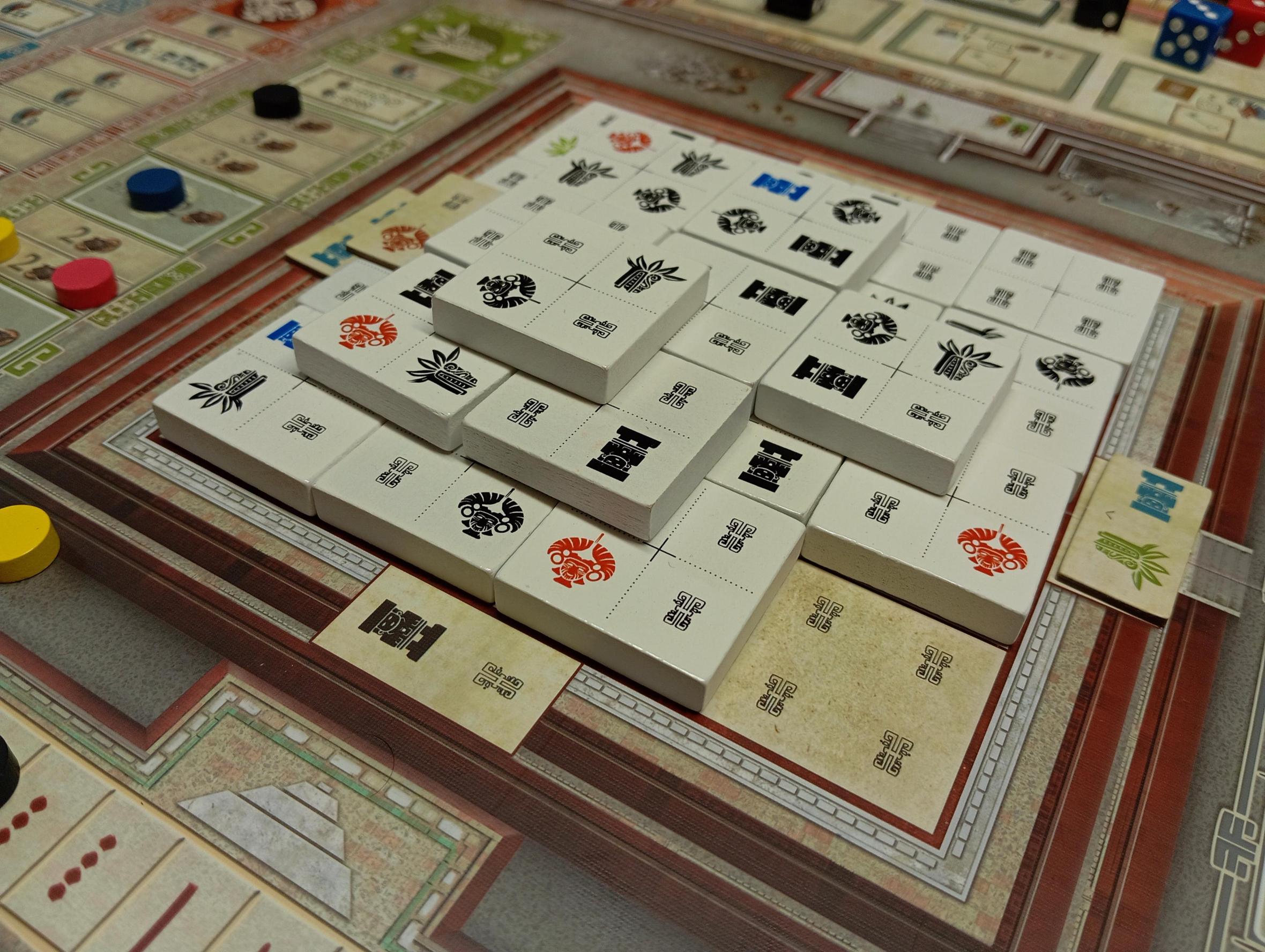
Où l'acheter
Prix des boutiques et exemplaires d'occasion, vérifiés chaque jour.
Sur les tables de Ludoya
Toutes les statistiques dans Ludoya- 823
- Parties enregistrées
- 634
- Joueurs
- 1h 53m
- Partie moyenne
- 183
- Dans des collections
- 33
- Dans des listes de souhaits
- 1
- Précommandé
6,3/10
sur 117 avis Ludoya
Jan Solo8,0 Gran juego de gestión de recursos y construcción de la pirámide. Modo solitario interesante, pero a mi gusto excesivamente farragoso y lento.
Evan2,5 In this game you move one of your player markers around a roundel 1-3 spaces then resolve the action in the space you end at. Your makers are dice, and the effect of the action spaces is based on a table that looks for how many of your dice are in the space, then also what the pip value of your lowest die is. Often the effect of the space will then add pips to one or two of your dice. When a die hits 6, it resets to 1, and you gain a step on a track that produces points at the end of the round per step you have. Then you also gain a reward from a small wheel of options next to that track. Mostly what you are doing is collecting bricks and wood, then spending the bricks and wood to build the structure at the center of the board. There are extremely important technology tiles you can invest in to make your actions better. Another key thing to manage is the need to spend cacao tokens equal to the number of players in an action space to resolve the action. If you can't pay it, then you wind up skipping your action and instead getting the cacao tokens plus 1 instead. You can avoid this by taking gather actions more often, but since there's very little if any engine building in the game, it does feel like a large portion of your actions in the game work out to similar feeling gather then spend cycles. When you take the action to build the central structure, some but not all of the tiles have colored icons that give you a free step on the matching temple track in addition to the large number of points produced by the action normally. Ability to build is dependent on a substantial number of turns setup, getting the resouces and lining your dice up. Temple track steps are somewhat hard to come by and each step produces points, resources or cacao in addition to having high value endgame scoring criteria at the top, so when you are ready to build and all the pieces are totally colorless, and then you flip up colored pieces for the next person so they can spend exactly what you did only they get a substantial additional return doesn't feel great. Temple builds additionally come with steps on a track that gives bonus 4 points each round to the player who built the most. The track rests right next to the building space and is clearly tied to it. The problem here is that there is a second space that adds stair tokens to the temple, with a different cost, and a different place on the roundel, which makes it needlessly hard to see who has the potential to gain a step and when. Additionally, the stair tokens have a pointlessly specific orientation they need to be placed at because there is a tiny hard to see arrow on the tile that has to point inward. This is there to make matching the icons when you place the stair token more luck driven for no reason I can understand. Additionally these tiles can have either one or two bonus colored icon payouts that again, depend on luck of what's available, again rewarding players for lucking into situations they had no control over establishing. There's also a confusing action space that we rarely saw used. It awards some points, gives you a step on the death track, and then reduces the value of being on that track for everyone. Why have a space that invests in a track, and then simultaneously reduces the value of that same track? When a player's marker goes from 1 to 6, you also click ahead the round timer, which additionally moves after each player has had an action. The game has two modes, one where the round ends the moment the marker hits the end of the track producing uneven turns, or when it hits the end of the track each player gets one more turn. Neither of these is great, because if you age out one of your markers in the final round it effectively doesn't change the pace of the game. Why not just have even turns without playing a whole additional round? I suppose it's due to the fact that when a player is about to age out a die is very unpredictable, since when you resolve a space with two age icons, you can age the same die twice, rather than having to spread it across two dice. What this means is that it's vastly more influential to the flow of the game to age out early in the round than later in the round. More unevenness to the feel and flow of the game. I additionally was confused by one special reward tile that you can spend to ignore paying a food cost, even the totality of food required at the end of the round to feed your people. So, spend it now to avoid paying 3 or 4 food for a crowded action space, or spend it at the end of the round to avoid paying up to 8. There's a massive point hit for not feeding your people, it seems like a pretty core 'watch yourself' mechanism, that you can just ignore for a round by virtue of taking this tile. Very odd. I don't know, this is an ok game were everything feels just a little off. A few minor changes and I think this could have been great, it just doesn't feel very interesting or cohesive. Any of the little things I'm complaining about could probably be forgiven if the core mechanism was more interesting. ★ Art, Iconography and components functional ☆ Clever or interesting mechanisms ★ Reasonably low downtime between turns with mildly AP players ★ Multiple plays stay interesting ☆ Low or mitigatable luck elements ★☆☆☆☆ Raw enjoyment
Garfield8,0 #50 [c] Theme: ★★★★☆ <!-- size 7]The pyramide is great --> Gameplay: ★★★★★ <!-- size 7]Lots of meaningful decisions --> Interaction: ★★★☆☆ <!-- size 7]Where are the other dice placed --> Artwork: ★★★☆☆ <!-- size 7]Ok --> Luck: ★★☆☆☆ <!-- size 7]Pyramid tiles available at your turn --> Strategy: ★★★★☆ <!-- size 7]Different strategies possible --> Components: ★★★★☆ <!-- size 7]Pyramide tiles are great --> Play duration: ★★★☆☆ <!-- size 7]Ok --> Easy to teach: ★★★☆☆ <!-- size 7]Ok --> Rules quality: <!-- size 7]not read --> Setup time: ★★☆☆☆ <!-- size 7]A lot to setup --> No downtime: ★★★☆☆ <!-- size 7]Ok --> Replay value: ★★★★★ <!-- size 7]Modular board, different strategies --> [/c]

Questions de règles
Réponses tirées du livret par l'assistant de règles de Ludoya.
Quand j’effectue une action principale, comment dois-je compter les ouvriers et combien de cacao dois-je payer ? Les ouvriers bloqués ou l’ouvrier que je viens de déplacer sont-ils pris en compte ?
Pour déterminer le coût en cacao, comptez d’abord le nombre d’ouvriers déverrouillés de couleurs différentes déjà présents sur le plateau (ignorez l’ouvrier qui arrive et les ouvriers verrouillés sur les espaces de vénération), puis payez cette quantité de cacao (p. 7). Pour résoudre les effets de l’action principale, comptez ensuite vos propres ouvriers déverrouillés sur ce plateau, y compris celui que vous venez de placer, mais jamais plus de 3 pour les besoins des effets (p. 7).
Quand je prends Récolter du cacao, quels ouvriers sont pris en compte — l’ouvrier qui arrive ou les ouvriers bloqués ?
Pour « Collect Cocoa », comptez le nombre d’ouvriers débloqués de couleurs différentes déjà présents sur le plateau d’actions (ne comptez pas l’ouvrier qui arrive ni les ouvriers verrouillés sur les espaces de culte), puis gagnez cette quantité plus 1 cacao ; placez ensuite votre ouvrier déplacé dans la zone générale (p. 6).
Que se passe-t-il exactement lorsqu’un ouvrier atteint le niveau de puissance 6 (Ascension) ? Est-ce que je déclenche immédiatement une Éclipse ?
L’Ascension se déclenche immédiatement lorsqu’un ouvrier est alimenté jusqu’à 6 : avancez sur l’Avenue des Morts, déplacez ce dé vers la zone générale du Palais et réinitialisez sa puissance à 1, choisissez une récompense d’Ascension, puis avancez le disque de lumière sur la piste du Calendrier (ce qui peut déclencher une Éclipse) — résolvez entièrement chaque Ascension et ne déclenchez l’Éclipse qu’après le tour, si nécessaire (p. 9).
Comment fonctionnent les restrictions de placement des Pyramides et des Décorations, et quand l’achèvement de la Pyramide met-il fin à la partie ?
Les tuiles Décoration doivent être placées uniquement sur les emplacements autorisés lorsque les niveaux de pyramide sous-jacents requis et les Décorations préalables sont présents, et vous marquez des points pour les icônes correspondantes lorsque vous recouvrez des tuiles (p. 8). Placer la tuile de sommet de la pyramide (quatrième niveau) nécessite d’avoir entièrement construit le troisième niveau en dessous, rapporte les PV indiqués et déplace immédiatement le disque blanc du Calendrier sur la position du disque noir, déclenchant l’Éclipse finale et mettant fin à la partie (p. 8).
Lorsque j’effectue une action Adoration, puis-je débloquer l’ouvrier d’un autre joueur et faire à la fois l’action d’adoration et prendre la tuile Découverte ? Dois-je payer quelque chose ?
Si le pion d’un autre joueur occupe l’espace Adoration, vous payez 1 cacao pour déverrouiller ce pion (déplacez-le vers la zone générale) avant de placer le vôtre ; vous ne pouvez pas déverrouiller vos propres pions de cette manière (p. 6). Vous choisissez ensuite soit d’activer la capacité d’Adoration, soit de prendre la tuile Découverte, soit de payer 1 cacao supplémentaire pour faire les deux (tous les coûts en cacao doivent être payés avant de résoudre les avantages). Si vous prenez une tuile, vous payez son coût indiqué (p. 6).
Jeux similaires






Gratuit, sur le web, Android et iOS
Jouez à Teotihuacan: La Cité Des Dieux avec Ludoya
- Gardez-le dans votre collectionSuivez votre exemplaire et ses extensions, prêtez-le à vos amis ou ajoutez-le à votre liste de souhaits et soyez prévenu quand le prix baisse.Ajouter à votre collection
- Enregistrez chaque partieScores, gagnants, minuteurs et photos, puis vos statistiques : taux de victoire, nombre de joueurs préféré, meilleur score.Enregistrer une partie
- Réglez les questions de règlesPosez n'importe quelle question sur les règles et obtenez une réponse tirée du livret, avec la page pour vérifier.Demander à l'assistant de règles
- Trouvez des gens avec qui y jouerClubs, soirées jeux et événements près de chez vous qui mettent ce jeu sur la table.Voir les événements
Données du jeu (joueurs, durée, âge, crédits) issues de BoardGameGeek.