
2019 · Négociation
Pax Pamir: Seconde Édition
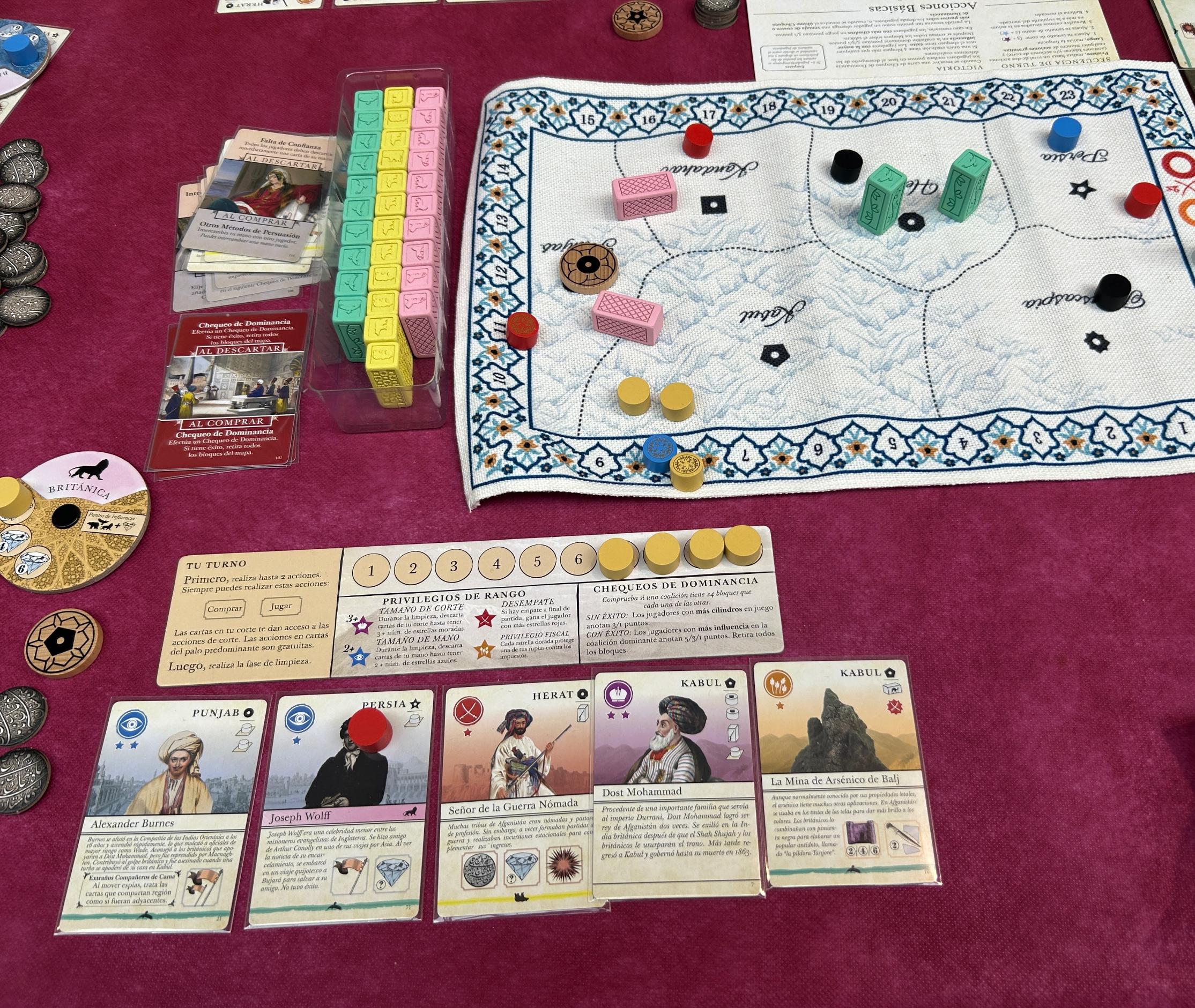
Les joueurs incarnent des dirigeants afghans du XIXe siècle qui composent avec des puissances étrangères rivales après l’effondrement de l’Empire durrani. Le jeu présente l’influence impériale du point de vue afghan : les joueurs recrutent des alliés, placent des unités militaires sur une carte commune et construisent un tableau personnel appelé une cour. Les tours consistent principalement à acheter des cartes sur un marché central et à les jouer en ligne pour obtenir des capacités, déployer des forces et déclencher des actions qui affectent les autres joueurs et le plateau. Des vérifications périodiques de domination déterminent si les coalitions ou le pouvoir local fragmenté dictent le décompte des points ; des points sont attribués soit pour l’influence d’une coalition, soit pour les bases de pouvoir individuelles. Le jeu alterne vérifications et réinitialisations jusqu’à ce qu’un joueur gagne en prenant une avance décisive ou à l’issue de la vérification finale.
- Joueurs
- 1–5 idéal à 4
- Temps de jeu
- 45–120 min
- Âge
- 13+
- Complexité
- 3,8 / 5
À propos du jeu
- Auteurs
- Illustration
- Publisher


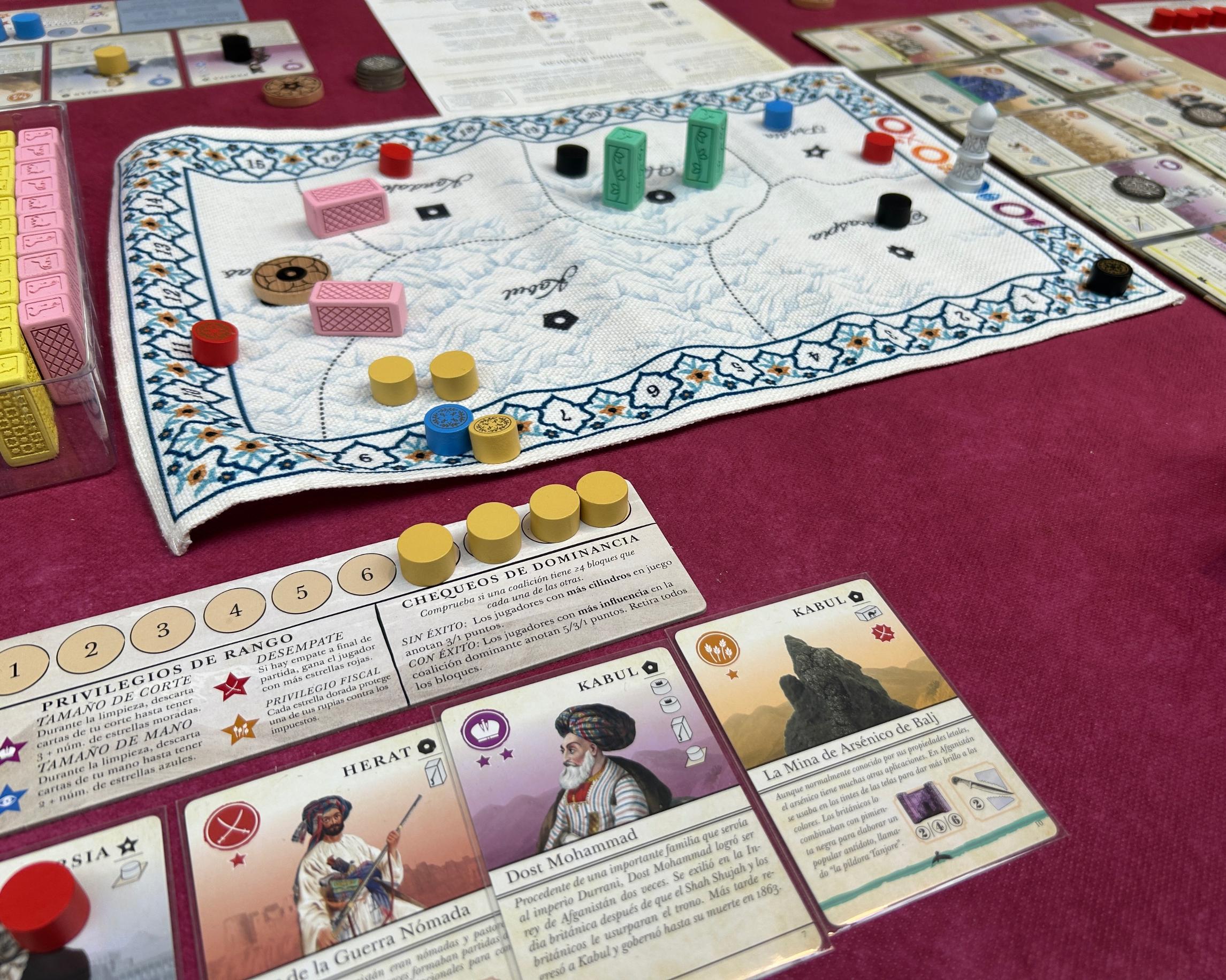
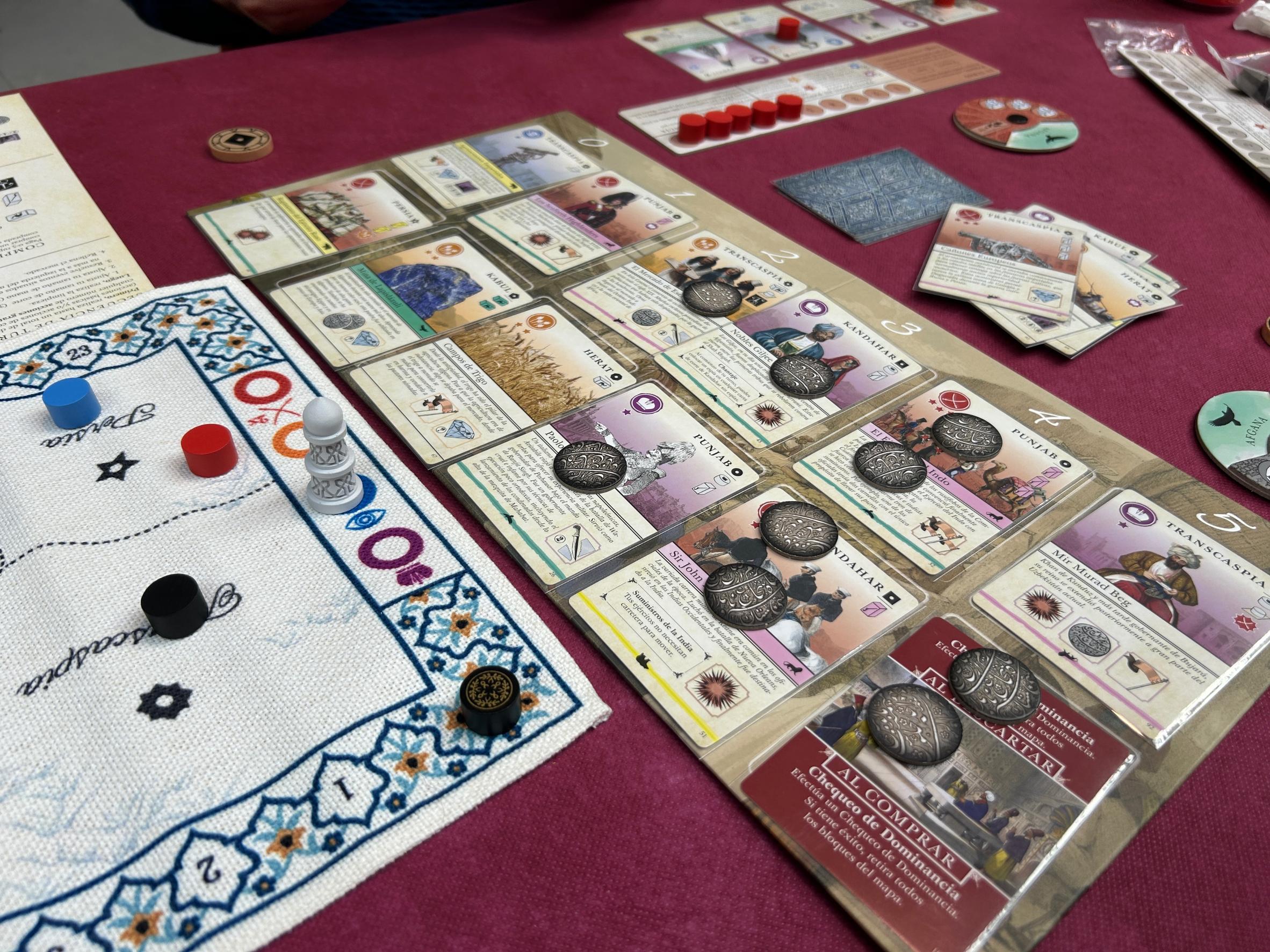
Photos des tables de Ludoya
Toutes les photos dans Ludoya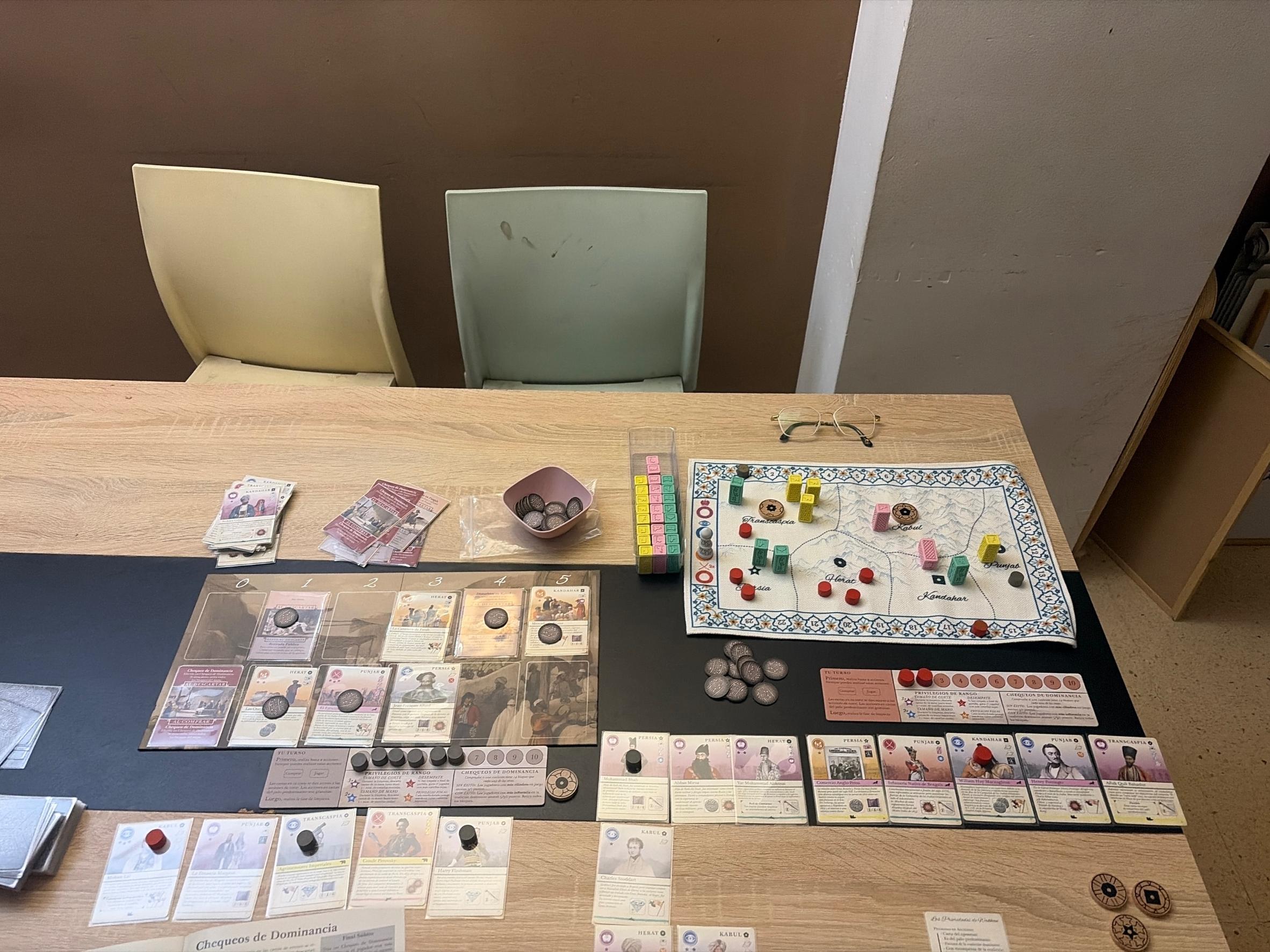
Où l'acheter
Prix des boutiques et exemplaires d'occasion, vérifiés chaque jour.
- Cardhaus GamesEn stock 65.99 $
- eFantasyEn stock 79.99 €
- GameplayVérifier le stock 84.95 €
- 401 GamesPrécommande 99.95 $
- PelipeikkoVérifier le stock 71.95 €
- GameologyEn stock 119.95 $
- Mono de JuegosRupture de stock 74.95 €
- Milan SpieleRupture de stock 77.2 €
Sur les tables de Ludoya
Toutes les statistiques dans Ludoya- 857
- Parties enregistrées
- 826
- Joueurs
- 1h 33m
- Partie moyenne
- 184
- Dans des collections
- 52
- Dans des listes de souhaits
8,3/10
sur 91 avis Ludoya
Balleflass10,0 Will probably rate it higher after more plays. Seems very promising so far. Simple and streamlined mechanics but still so complex because of the hostage/ruling-tax/bribery mechanic on top of the often changing allegiances. Great game. EDIT* Yeah, thought so, this is a 10. Also, thanks to this game, I can sell about 40-50% of my collection. Paladin 63.5x88mm double matte (old style).
Garfield9,0 #29.1 Very interesting game. Meaningful decisions to make and a lot of interaction. [c] Theme: :star::star::star::nostar::nostar: <!-- size 7]Ok --> Gameplay: :star::star::star::star::nostar: <!-- size 7]Many meaningful decisions --> Interaction: :star::star::star::star::star: <!-- size 7]A lot of different interaction --> Artwork: :star::star::star::star::nostar: <!-- size 7]Nice --> Luck: :star::star::star::nostar::nostar: <!-- size 7]Random cards --> Strategy: :star::star::star::star::nostar: <!-- size 7]Multiple strategies possible --> Components: :star::star::star::star::nostar: <!-- size 7]Very nice --> Play duration: :star::star::star::nostar::nostar: <!-- size 7]Ok for such a game --> Easy to teach: :star::star::star::nostar::nostar: <!-- size 7]Ok (45min) --> Rules quality: :star::star::star::star::nostar: <!-- size 7]Very good --> Setup time: :star::star::nostar::nostar::nostar: <!-- size 7]Card deck takes some time --> No downtime: :star::star::star::nostar::nostar: <!-- size 7]Ok --> Replay value: :star::star::star::star::nostar: <!-- size 7]Different strategies possible --> [/c]
andycted9,0 (Update after a few more games with experienced people) This game has two phases, in its life on your shelves. The first one is the one where you internalise not only rules, but dynamics and interactions. At that point you will have a lot of fun already, but some stuff will appear a bit clunky and out of place (double scoring, calculations on dominance scoring, five players, etc). All this disappears the moment you stop calculating and playing the market/board only and instead mainly playing your opponents, the alliances and guessing their objectives. Then the game opens itself and becomes excellent at any player count. Needs players willing to give and receive punches but more importantly, to negotiate and talk
Questions de règles
Réponses tirées du livret par l'assistant de règles de Ludoya.
When does a Dominance Check happen and how is it scored?
Dominance Checks are resolved when a Dominance Check event is purchased or when one is revealed during cleanup, and final-check points are doubled (page 9, 15). If a single coalition has the most blocks and at least four more than each other coalition the check is successful and loyal players score by influence (5/3/1); otherwise players score for cylinders in play (3/1) with ties split as described (page 15).
Do I have to pay a bribe if I play a card from a region someone else rules?
Yes — if another player rules the card’s region you must pay them a bribe equal to the number of that ruler’s tribes in the region (the ruler may waive any portion); if you don’t pay (or it’s not waived) the play is canceled as if it never happened (page 11).
How does the favored suit affect actions and purchase costs?
The favored suit determines which court cards grant bonus actions that do not count against your two-action limit, and the favored-suit marker can be moved by cards you play (pages 6, 12, 11). If the military suit is favored, purchase costs are doubled — you place two rupees on each leftward market card when buying (page 10).
How do I pay for a card in the market and what happens to rupees I place there?
A card’s cost depends on its column (leftmost free, then 1, 2, etc.); you pay by placing one rupee on each card to the left in the same row (if a slot is vacant you pay to the opposite row's same column), and any time you place a rupee on a market card you may not purchase that particular card that turn (page 10). Action costs that pay the market place rupees on the rightmost market cards of both rows and follow the same purchase-blocking rule (page 12).
What does it take to 'rule' a region and when do I take the ruler token?
To take a region’s ruler token you must have at least one tribe in the region and a plurality of ruling pieces (more than any other player individually); if there is a tie no one rules the region, and ruler tokens are taken or returned immediately when ruling status changes (page 7).
How does the Betray action work and what is a prize?
Betray discards a card where you have a spy (cost 2) and you may then accept the discarded card as a prize by tucking it behind your loyalty dial; if the prize’s coalition differs from your current loyalty you must remove your gifts, prizes, and patriots matching your old loyalty and then change loyalty (page 14, page 7).
Jeux similaires
 Pax Renaissance2016
 Pax Pamir2015
 John Company: Seconde Édition2023
 Through the Ages: L'Histoire vous appartient2010
 Pax Renaissance 22024
 Through the Ages: L'Histoire vous appartient2016
 Pax Porfiriana2012
 John Company2017
 Dune: Imperium2021
 Castles of Mad King Ludwig: Collector's Edition2022
 Pax Viking2023
 Root2019



Gratuit, sur le web, Android et iOS
Jouez à Pax Pamir: Seconde Édition avec Ludoya
- Gardez-le dans votre collectionSuivez votre exemplaire et ses extensions, prêtez-le à vos amis ou ajoutez-le à votre liste de souhaits et soyez prévenu quand le prix baisse.Ajouter à votre collection
- Enregistrez chaque partieScores, gagnants, minuteurs et photos, puis vos statistiques : taux de victoire, nombre de joueurs préféré, meilleur score.Enregistrer une partie
- Réglez les questions de règlesPosez n'importe quelle question sur les règles et obtenez une réponse tirée du livret, avec la page pour vérifier.Demander à l'assistant de règles
- Trouvez des gens avec qui y jouerClubs, soirées jeux et événements près de chez vous qui mettent ce jeu sur la table.Voir les événements
Données du jeu (joueurs, durée, âge, crédits) issues de BoardGameGeek.