
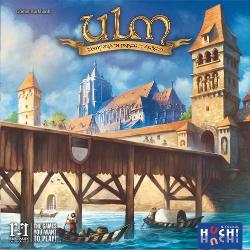
2016 · Médiéval
Ulm
Les joueurs étendent leur influence dans une prospère ville libre d’Empire du début du XVIe siècle, tandis que la cathédrale est en construction. À chaque tour, une tuile Action est poussée dans une grille de la cathédrale de 3×3 afin d’effectuer les trois actions liées qu’elle déclenche, comme commercer des marchandises, recruter des artisans, gagner de l’influence auprès des guildes et des patriciens, et faire avancer la tour de la cathédrale. La partie se déroule sur un nombre fixe de manches ; les joueurs gèrent leurs ressources, leur temps et le placement de leurs ouvriers pour marquer des points de victoire dans les domaines du marché, de l’artisanat et de la vie civique. Le joueur ayant le plus de points lorsque la cathédrale est achevée remporte la partie.
- Joueurs
- 2–4 idéal à 3
- Temps de jeu
- 45–75 min
- Âge
- 10+
- Complexité
- 2,7 / 5
À propos du jeu
- Auteurs
- Illustration
Photos des tables de Ludoya
Toutes les photos dans Ludoya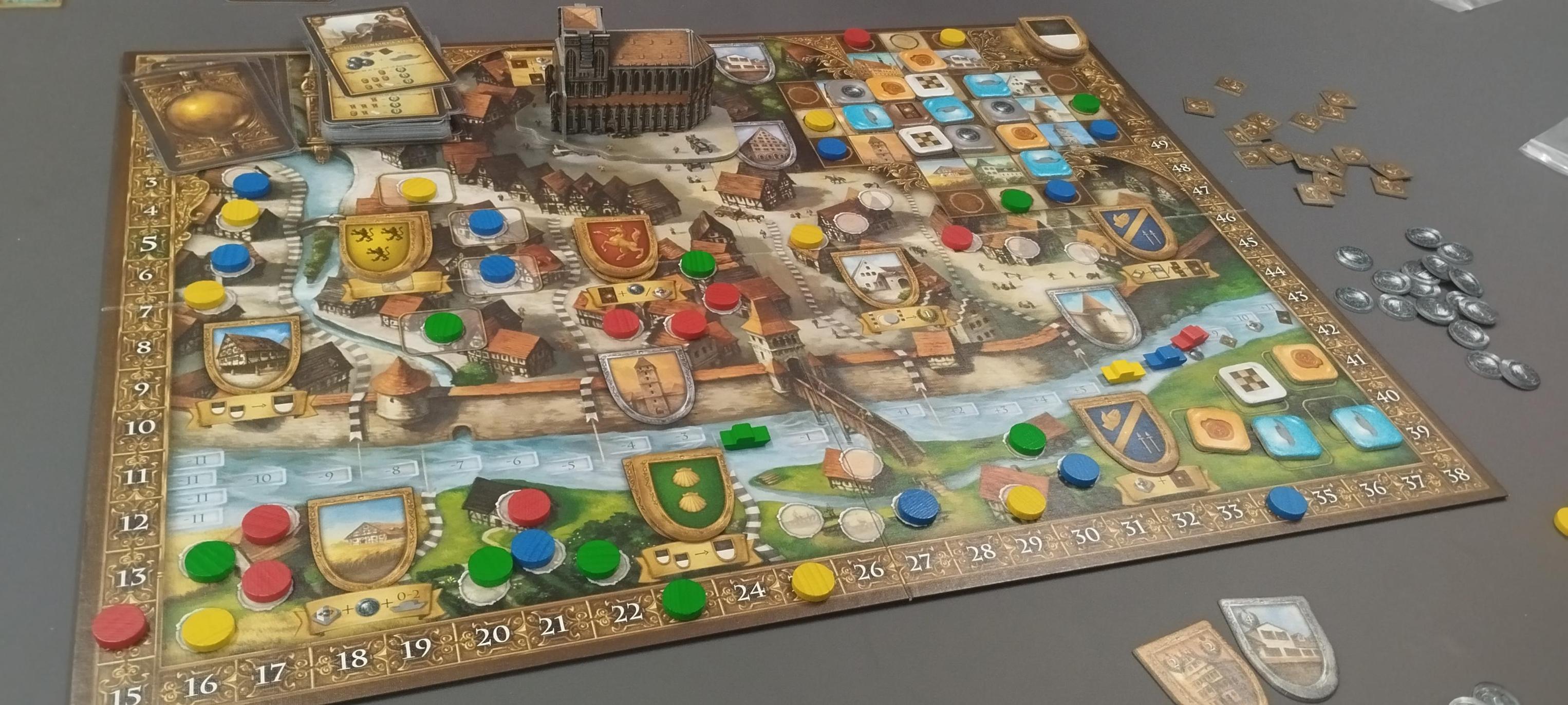
Où l'acheter
Prix des boutiques et exemplaires d'occasion, vérifiés chaque jour.
Sur les tables de Ludoya
Toutes les statistiques dans Ludoya- 101
- Parties enregistrées
- 99
- Joueurs
- 1h 22m
- Partie moyenne
- 19
- Dans des collections
- 3
- Dans des listes de souhaits
4,6/10
sur 19 avis Ludoya
Evan2,5 Ulm felt like it could have been a great game. interesting action selection mechanism, players claiming areas so they get a benefit when someone else resolves an action... Unfortunately it fell flat mostly due to randomness. Annoyingly, the rulebook is split across two books for no reason. This makes looking things up a challenge. Then, the basic mechanism of the game is, draw a tile, push it into a row, resolve the 3 central actions in any order of your row including the tile you pushed in. You start the game with 1 tile in your "supply" one might imagine this means you draw a tile, add it to your hand, then choose a tile from your hand and push it in. Unfortunately, the rules state you must push in the tile you drew that turn, so you get to know what 2 of your 3 actions are and the third is totally random. The tiles in your supply are used only for discarding to pay for the effect of, or to acquire cards. The cards when played have a choice of giving you an immediate effect or adding them to end of game scoring sets. Of course, getting and playing these cards requires some luck in terms of what tile effect you are able to activate. One of the actions is a seal, which lets you place a marker either above or below your boat along the river. This is an interesting limitation on your actions, because you want to move the boat along the river, because that's where points are, but the further you go the more actions are no longer available to you. Here's the problem. The actions above and below the river are what get claimed by players. One of the river abilities is to randomly draw 2 location tiles keep one. About half of them are one and done score points, the other half let you claim locations. So maybe you draw the location that's at the start of the river late in the game when nobody can resolve that action anymore. The game does have some luck mitigation. Most things are draw 2 keep 1 and there are ability tiles that can mitigate some of the luck. There are also sparrow tokens worth 1vp each if unspent, that can be spent to let you swap your draw with one from a faceup market display. The question is, how many times do you spend 1vp to swap your useless draw for an ok tile before the market is full of garbage and you are out of 1vp tiles? :nostar: Art, Iconography and components functional :star: Clever or interesting mechanisms :star: Reasonably low downtime between turns with mildly AP players :star: Multiple plays stay interesting :nostar: Low or mitigatable luck elements :star::nostar::nostar::nostar::nostar: Raw enjoyment
Garfield5,0 #AreaControl #SetCollecting Themeless and pretty much luckbased. [c] Theme: :star::nostar::nostar::nostar::nostar: <!-- size 7]Not really --> Gameplay: :star::star::nostar::nostar::nostar: <!-- size 7]Slightly boring --> Interaction: :star::nostar::nostar::nostar::nostar: <!-- size 7]Nope --> Artwork: :star::star::nostar::nostar::nostar: <!-- size 7]Nothing special --> Luck: :star::star::star::star::nostar: <!-- size 7]Card drawing luck, tile drawing luck --> Strategy: :star::star::nostar::nostar::nostar: <!-- size 7]Little --> Components: :star::star::star::nostar::nostar: <!-- size 7]Good --> Play duration: :star::star::star::nostar::nostar: <!-- size 7]Ok, but could be shorter --> Easy to teach: :star::star::nostar::nostar::nostar: <!-- size 7]A lot of actions to explain --> Setup time: :star::star::star::star::nostar: <!-- size 7]Quick --> No downtime: :star::star::star::nostar::nostar: <!-- size 7]Little to huge --> [/c]
Questions de règles

Gratuit, sur le web, Android et iOS
Jouez à Ulm avec Ludoya
- Gardez-le dans votre collectionSuivez votre exemplaire et ses extensions, prêtez-le à vos amis ou ajoutez-le à votre liste de souhaits et soyez prévenu quand le prix baisse.Ajouter à votre collection
- Enregistrez chaque partieScores, gagnants, minuteurs et photos, puis vos statistiques : taux de victoire, nombre de joueurs préféré, meilleur score.Enregistrer une partie
- Comptez les points sans papierUtilisez les feuilles de score et les aides de jeu de la communauté, et laissez Ludoya additionner les points.Trouver des feuilles de score
- Trouvez des gens avec qui y jouerClubs, soirées jeux et événements près de chez vous qui mettent ce jeu sur la table.Voir les événements
Données du jeu (joueurs, durée, âge, crédits) issues de BoardGameGeek.